By submitting you consent to receive service-related texts from Drastic Drainage. Reply STOP to opt out. Msg & data rates may apply. Consent not required to book service.
Useful Links
Most septic problems don’t announce themselves until something backs up, smells wrong, or shows up in the yard. By that point, you’re not dealing with a maintenance call anymore you’re dealing with a repair. Staying ahead of that is the entire point of routine pumping, and in Westhampton Beach, the stakes are higher than most places on Long Island.
If you’re renting your property seasonally Dune Road, Oneck Lane, anywhere in the village your system is absorbing a summer’s worth of maximum-capacity use in a compressed window. A system that was last serviced two or three years ago and has been sitting at low load through the off-season is not ready for eight people in July. Getting it pumped before the season starts means you’re not fielding a call from your tenants on a Saturday in August about sewage backing up into the bathroom.
For year-round residents and second-home owners alike, a properly maintained system also means you know what you have. Westhampton Beach’s older housing stock a meaningful share of homes here predate 1978 includes cesspools and septic tanks that have gone years without professional attention. When you get a real pump-out and a real assessment, you’re not guessing anymore. You know the condition of the system, what it needs, and what it doesn’t. That peace of mind is worth more than the service itself.
The standard guidance for septic tanks is every three to five years, but that assumes consistent year-round occupancy and average household water use. Westhampton Beach properties often don’t fit that profile. If your home sits mostly vacant from October through May and then hosts a full house of summer renters from June through August, your system is experiencing load patterns that compress years of normal use into a few months. That changes the math.
Properties on or near Dune Road, Moniebogue Bay, or the village’s tidal creek corridors also deal with higher groundwater tables than inland Suffolk County communities. When the water table is closer to the surface, drainfields saturate faster and systems fill more quickly than standard pumping intervals account for. For a Westhampton Beach seasonal rental property, we recommend having the system pumped before each rental season begins not on a fixed multi-year calendar. For year-round residents with a standard household, every two to three years is a reasonable baseline, but we can give you a more accurate recommendation based on your specific system.
A proper pump-out removes all of the accumulated sludge and waste from the tank not just the surface layer. This is worth asking about directly, because partial pump-outs are a real practice among low-cost operators. If a technician is on-site for fifteen minutes and gone, that’s a signal worth paying attention to.
Beyond the pump-out itself, a quality service visit should include a check of the tank’s baffles, an assessment of the tank’s structural condition, and a look at whether there are signs of groundwater infiltration or drainfield stress. In Westhampton Beach, where coastal water tables can accelerate system wear, catching early signs of drainfield saturation is the difference between a manageable maintenance issue and a much larger repair. After the job, the septage has to be transported to a licensed treatment facility this is a legal requirement under New York State and Suffolk County regulations, and not every operator handles it properly. A company operating with a valid Suffolk County Liquid Waste License is required to meet this standard.
This is more common than most people realize, especially in Westhampton Beach where a significant portion of the housing stock was built before 1978 and many properties have changed hands multiple times without proper system documentation. Cesspools and septic tanks on older properties are frequently buried under years of soil and landscaping, and previous owners don’t always leave records.
We specifically list locating hard-to-find cesspools and septic tanks as one of our service specialties. The process typically involves probing the ground in likely locations based on the home’s age, layout, and plumbing configuration, and sometimes using locating equipment to identify the tank without excavating the entire yard. Once the lid is located, if it’s buried, excavation is needed to access it this is a standard part of the service on older properties, not an unexpected add-on. We’ll walk you through what we find and what the system looks like before any work begins. If you’ve just purchased a home in Westhampton Beach and have no documentation of the system’s history, this is exactly the kind of visit that gives you a real baseline.
Only if your property is within the Phase I service area, which covers a specific section of the Main Street commercial corridor roughly from Potunk Lane to Beach Road, bounded by Stevens Lane to the south. That district was completed in 2023 and serves approximately 156 tax lots, primarily the downtown business district and a limited number of adjacent condominium and high-density residential properties.
If your property is anywhere outside that boundary Dune Road, Oneck Lane, the Jessup Neck area, the residential streets north and south of Main Street, or the surrounding hamlets of Remsenburg, Quiogue, Speonk, or West Hampton Dunes you are still on a private septic system or cesspool. The sewer district does not extend to Westhampton Beach’s residential neighborhoods, and there are no current announced plans to expand it to those areas. Your system remains your responsibility, and regular pumping is still the most important thing you can do to protect it and avoid a much more expensive repair down the road.
It matters for a few reasons. A cesspool is a simpler system it’s essentially a perforated concrete ring buried in the ground that allows liquid waste to leach out while solids accumulate at the bottom. A septic tank is a two-chamber system that separates solids from liquids before the effluent moves to a drainfield. Cesspools are far more common on Long Island’s older properties, and Westhampton Beach has plenty of both.
The difference affects pumping frequency. Because cesspools don’t separate waste the way a septic tank does, they accumulate solids faster and typically need pumping every one to two years. Septic tanks, with proper use and average occupancy, can go three to five years between pump-outs. In Westhampton Beach, where seasonal rental loads can push a system hard in a short window, the frequency recommendation shifts regardless of system type. If you’re not sure what you have, a technician can identify the system type during the service visit and that information is worth having before you set any kind of maintenance schedule.
The risk is that by the time there’s an obvious problem slow drains, a smell in the yard, sewage backing up into the house the system is already in significant distress. Septic systems don’t usually fail all at once with clear warning signs. They degrade gradually, and the visible symptoms show up late in that process.
In Westhampton Beach, the consequences of a failed system are more immediate and more expensive than in most places. If your property is a seasonal rental and the system backs up in July, you’re not just looking at a repair bill you’re looking at a lost rental season, potential liability to tenants, and emergency service costs that are higher than routine maintenance by a wide margin. A failed drainfield can cost well into the five figures to repair or replace, and under Suffolk County’s current regulations, a failed cesspool cannot simply be replaced in kind it has to be upgraded to a more advanced system. The cost difference between staying on a regular pumping schedule and dealing with a system failure is substantial. Routine service is the cheaper option by a significant margin, and it’s the one that keeps your property usable when it needs to be.
Free, no-obligation estimates on cesspool, sewer, and drain work.
We get there quickly. No waiting days for a callback.
Backups don’t wait for business hours. Neither do we.
Fully licensed and insured across Long Island.
Up-to-date trucks and tools for cleaner, faster jobs.
Straight quotes, no surprises on the bill.
Hear from Our Customers
Most septic problems don’t announce themselves until something backs up, smells wrong, or shows up in the yard. By that point, you’re not dealing with a maintenance call anymore you’re dealing with a repair. Staying ahead of that is the entire point of routine pumping, and in Westhampton Beach, the stakes are higher than most places on Long Island.
If you’re renting your property seasonally Dune Road, Oneck Lane, anywhere in the village your system is absorbing a summer’s worth of maximum-capacity use in a compressed window. A system that was last serviced two or three years ago and has been sitting at low load through the off-season is not ready for eight people in July. Getting it pumped before the season starts means you’re not fielding a call from your tenants on a Saturday in August about sewage backing up into the bathroom.
For year-round residents and second-home owners alike, a properly maintained system also means you know what you have. Westhampton Beach’s older housing stock a meaningful share of homes here predate 1978 includes cesspools and septic tanks that have gone years without professional attention. When you get a real pump-out and a real assessment, you’re not guessing anymore. You know the condition of the system, what it needs, and what it doesn’t. That peace of mind is worth more than the service itself.
We’ve been working on Long Island’s cesspools and septic systems for over 30 years. That’s not a headline it’s the reality of what it takes to know this specific environment. Westhampton Beach’s coastal properties, older housing stock, and high groundwater conditions near Moniebogue Bay are genuinely different from what you’d find anywhere else, and experience here means something.
We’re locally owned and operated, based in West Babylon, and serve all of Suffolk County including Westhampton Beach and the surrounding Southampton Town communities. When you call, you’re reaching a real Long Island operation with a crew that has seen the full range of what these systems look like, from buried lids on pre-war properties to drainfields struggling with coastal water tables.
Our approach is straightforward: assess honestly, do the work that’s actually needed, and tell you what’s going on before anything gets started. No inflated estimates, no pressure to approve work you don’t need. That’s our policy, and it’s stated plainly not buried in fine print.

It starts with a call and a free estimate. Before anyone shows up at your property, you’ll know what to expect the scope of the work, what the visit involves, and what it costs. That estimate doesn’t change when the truck arrives.
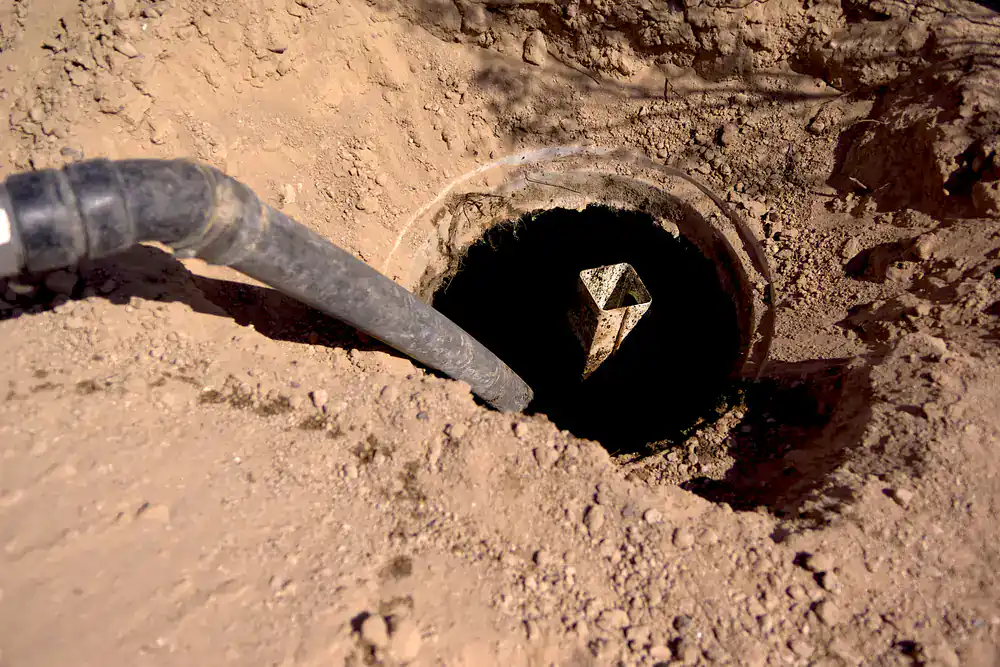
On-site, the first step is locating and accessing the tank. For a lot of Westhampton Beach properties especially older homes and estates where the system was never properly documented this is where experience matters. We specialize in locating hard-to-find cesspools and septic tanks, which is a real issue on properties where the system was installed decades ago and nobody kept records.
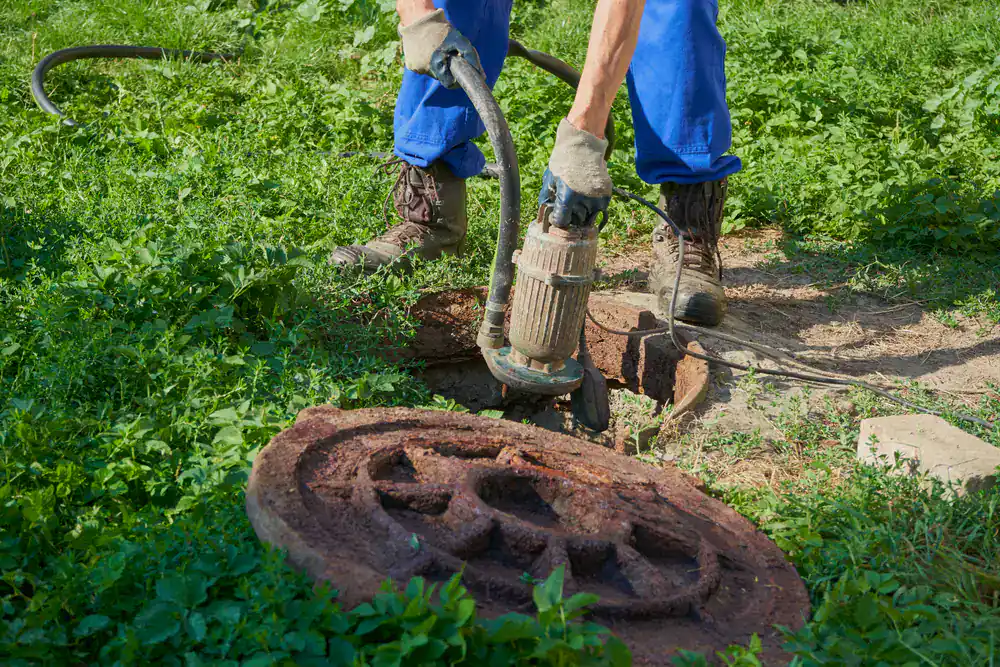
Once the lid is located and accessed, the pump-out begins. A full pump-out means removing all of the accumulated sludge and waste not a partial pull that leaves the tank half-full and has you calling again in six months. After pumping, we assess the system’s condition. Baffles, tank integrity, signs of infiltration or drainfield stress these are things a quality service checks, not skips. If there’s something worth knowing, you’ll hear about it clearly and without pressure.
The septage is then transported and disposed of at a licensed treatment facility, which is a legal requirement in Suffolk County and not something every low-price operator handles correctly. You’ll know the job is done when the crew leaves the property in the condition they found it.
Ready to get started?
Septic tank pumping is the core of what we do in Westhampton Beach, but it’s rarely the only thing a property needs. We handle cesspool pumping and cleaning, septic and cesspool installation, drain cleaning, drywell cleaning, house trap replacements, main sewage line cleaning and replacement, and holding tank pumping. For larger properties Oneck Lane estates, Dune Road homes with more complex system configurations having one company that can assess and address the whole system is a practical advantage.
Westhampton Beach sits within Suffolk County, where all cesspool and septic work is governed by the Suffolk County Liquid Waste License under Chapter 563, Article VII. This license requires verified trade experience and ownership of a dedicated pump and vacuum truck it’s not a formality. The 2019 regulatory change in Suffolk County also means that any failed cesspool requiring replacement must be upgraded to a more advanced system, not replaced in kind. If your system is aging and a technician identifies signs of failure, knowing your options upfront matters.
The village’s Phase I sewer district, completed in 2023, covers the Main Street commercial corridor but the vast majority of Westhampton Beach’s residential properties remain on private septic. Dune Road, Oneck Lane, the Jessup Neck area, the surrounding hamlets of Remsenburg, Quiogue, and Speonk all of it is still your responsibility to maintain. We’re available 24 hours a day, seven days a week, including weekends and holidays, for both routine service and emergency response.