
By submitting you consent to receive service-related texts from Drastic Drainage. Reply STOP to opt out. Msg & data rates may apply. Consent not required to book service.
Useful Links
Most Commack homeowners don’t think about their cesspool until something goes wrong. A slow drain here, a smell outside there — and then one day the system backs up completely and the bill is nothing like what a routine pump-out would have cost. The difference between catching it early and letting it slide is usually just time.
Here’s what makes Commack specifically worth paying attention to. The majority of homes in this community were built during the suburban boom of the 1950s and early 1960s, which means the cesspools beneath them are original single-chamber systems — the kind that handle both liquid and solid waste in the same space, without separation. They fill faster than modern designs. They give fewer warning signs. And when they do fail, they tend to fail in a specific way: solids migrate from the main chamber into the leaching pool, and at that point, pumping alone doesn’t solve it.
Commack’s sandy, permeable soil makes this worse, not better. Water drains fast here, which sounds like a good thing — until a cesspool is leaking. In that case, contaminants move quickly through the ground and toward the sole-source aquifer that supplies the area’s drinking water. Getting the system serviced on a proper schedule isn’t just about avoiding a messy backup. It’s about protecting a property that’s worth anywhere from $678,000 to over $850,000 in today’s market.
For most Commack households, a pump-out every two to three years is a reasonable baseline — but it depends on how many people are in the home and how much water the household uses daily. A family of four in a three-bedroom home is going to fill a system faster than a retired couple in the same house.
What makes Commack worth paying extra attention to is the age of the housing stock. These original single-chamber systems from the 1950s and 60s don’t have the separation capacity of newer designs, so solids accumulate in the main chamber faster. Letting a pump-out schedule slide by even a year or two beyond what’s appropriate for your household size is how solids end up migrating into the leaching pool — and that’s when a routine service call becomes a much larger repair. Getting on a regular schedule is the simplest way to avoid that outcome.
The most common early signs are slow drains throughout the house — not just one sink, but multiple fixtures draining sluggishly at the same time. Gurgling sounds from toilets or drains, especially after running water elsewhere in the house, are another indicator. A persistent sewage smell near the yard, particularly around where the system is located, means the cesspool is at or past capacity.
The more serious signs are a wet or spongy patch of ground above the system even when it hasn’t rained, or sewage surfacing in the yard. At that point, the system isn’t just full — it’s actively failing, and the ground above it is saturated with effluent. In Commack’s sandy soil, that material moves fast. It doesn’t pool and sit; it percolates directly toward the aquifer. If you’re seeing any of those signs, a same-day call is appropriate — not something to monitor for another week.
Yes, and it’s not optional. When a Commack home sells — especially at the price points common in the 11725 ZIP code — the cesspool becomes a required disclosure and documentation point. The buyer’s mortgage lender will typically require proof that the system is functional and compliant. The attorneys handling the transaction will want documentation. And the Suffolk County Department of Health Services has its own inspection requirements for property transfers.
What this means practically is that you want the inspection done before you’re under contract, not after. If an inspection reveals a problem during the sale process, you’re negotiating from a weaker position with a closing date bearing down. Getting the system assessed and certified ahead of listing gives you time to address anything that comes up on your terms — and it removes one of the most common friction points in a Commack home sale. We provide the written certifications that satisfy the lender, attorney, and county requirements.
Free, no-obligation estimates on cesspool, sewer, and drain work.
We get there quickly. No waiting days for a callback.
Backups don’t wait for business hours. Neither do we.
Fully licensed and insured across Long Island.
Up-to-date trucks and tools for cleaner, faster jobs.
Straight quotes, no surprises on the bill.
Hear from Our Customers

Most Commack homeowners don’t think about their cesspool until something goes wrong. A slow drain here, a smell outside there — and then one day the system backs up completely and the bill is nothing like what a routine pump-out would have cost. The difference between catching it early and letting it slide is usually just time.
Here’s what makes Commack specifically worth paying attention to. The majority of homes in this community were built during the suburban boom of the 1950s and early 1960s, which means the cesspools beneath them are original single-chamber systems — the kind that handle both liquid and solid waste in the same space, without separation. They fill faster than modern designs. They give fewer warning signs. And when they do fail, they tend to fail in a specific way: solids migrate from the main chamber into the leaching pool, and at that point, pumping alone doesn’t solve it.
Commack’s sandy, permeable soil makes this worse, not better. Water drains fast here, which sounds like a good thing — until a cesspool is leaking. In that case, contaminants move quickly through the ground and toward the sole-source aquifer that supplies the area’s drinking water. Getting the system serviced on a proper schedule isn’t just about avoiding a messy backup. It’s about protecting a property that’s worth anywhere from $678,000 to over $850,000 in today’s market.
We’ve been working on Nassau and Suffolk County cesspools for over 30 years. That’s not a number to fill space — it means we’ve spent decades learning the specific system designs, buried access points, and failure patterns that come with Commack’s post-war housing stock. The kind of experience you only get from doing this work, in this community, year after year.
Commack is an area we know well. The homes along Jericho Turnpike and back through the neighborhoods near Hoyt Farm Nature Preserve are largely the same era — original systems, often with no visible cover, sometimes with no service history anyone can track down. That’s a familiar situation, and it’s not one that rattles us. We come in, locate the system if needed, assess it honestly, and tell you what it actually requires — nothing more.
We’re licensed (LW-63684), insured, and bonded. Free estimates before any work begins, and a real person picks up when you call.
When you call us, a real person answers — not a voicemail, not a callback queue. You describe what’s going on, and we give you a straight read on what it sounds like and when we can be there. For emergencies, that availability extends around the clock, because a cesspool backup at 10 PM on a Sunday doesn’t wait for business hours.
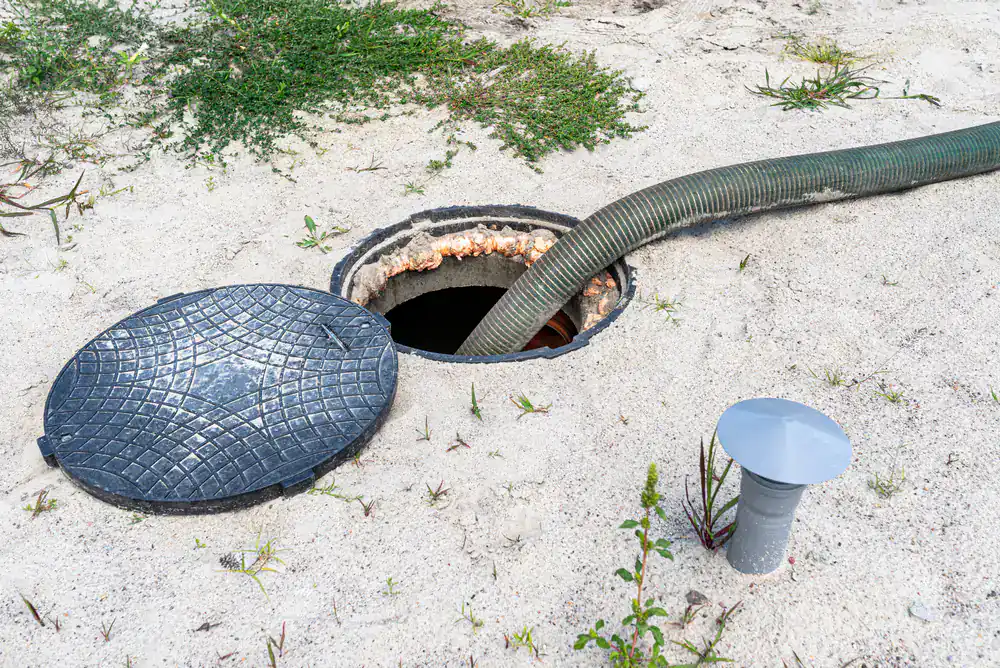
When our crew arrives, the first step is assessment. On a lot of Commack properties — especially homes built before 1970 — the cesspool cover has been buried under decades of landscaping or resurfacing. If there’s no visible access point, we locate it. Once we have access, we inspect the system before anything else. If the situation calls for it, we run a waterproof camera through the pipes to see exactly what’s happening underground. That step alone prevents a lot of unnecessary digging through established yards.
From there, the scope of work is defined before we start. You know what needs to be done, why it needs to be done, and what it’s going to cost — before anyone picks up a shovel. Suffolk County requires permits for installations and major repairs, and we handle that process as part of the job. When the work is finished, we walk you through what was done and what to watch for going forward.

Ready to get started?
We handle the full range of cesspool and drainage work — not just pump-outs. Routine cesspool cleaning and pumping is the foundation, but the service list goes well beyond that. Leaching pool cleaning, drywell cleaning, video pipe inspections, cesspool location on properties with no visible access point, main sewage line cleaning and replacement, house trap replacements, storm drain cleaning, and cesspool installation — it’s all handled in-house, by the same team.
One service that matters specifically in Commack’s real estate market is cesspool certification for property transfers. When a home in this community sells — and at these price points, the stakes are real — the buyer’s lender, the attorneys on both sides, and the Suffolk County Department of Health Services each independently require documentation on the system’s condition. We provide the inspections and written certifications that satisfy all three. If you’re preparing to list a home on Jericho Turnpike or anywhere else in the 11725 ZIP code, that’s a detail worth sorting out before you’re under contract and on a closing timeline.
It’s also worth knowing that since July 2019, Suffolk County has prohibited new traditional cesspool installations. If your system fails and needs full replacement, it must be replaced with an Innovative/Alternative treatment system. The county’s Septic Improvement Program now reimburses up to 75% of the project cost — up to $25,000 — for qualifying upgrades. We can walk you through what applies to your property.
