By submitting you consent to receive service-related texts from Drastic Drainage. Reply STOP to opt out. Msg & data rates may apply. Consent not required to book service.
Useful Links
Living on a peninsula surrounded by Huntington Bay, Long Island Sound, and Cold Spring Harbor means your cesspool is dealing with conditions that inland Suffolk County homeowners simply don’t face. The water table here is subject to tidal influence. After a nor’easter pushes water levels up across the entire peninsula, a system that was functioning fine last week can show real signs of stress — not because it’s failing, but because the coastal environment changed the rules on it. Getting ahead of that is what separates a routine service call from an emergency.
When your system is properly maintained and operating the way it should, the difference is noticeable. No slow drains. No odors surfacing in the yard. No anxiety about what’s happening underground when your family is home for the holidays or guests are staying the weekend. For a property in Lloyd Harbor — where the average home value sits above two million dollars — a well-maintained cesspool is also a protected investment. A system that fails and needs full replacement can’t be swapped for another conventional cesspool under Suffolk County’s 2019 ban. It has to be upgraded to an Innovative/Alternative system, which is a significantly larger undertaking.
The good news is that most of those situations are preventable. Regular maintenance, proper inspection intervals, and a provider who understands the specific behavior of coastal peninsula systems makes all the difference. That’s the outcome worth focusing on — not just fixing what’s broken, but keeping it from breaking in the first place.
Lloyd Harbor sits on a peninsula with water on three sides — Huntington Bay, Long Island Sound, and Cold Spring Harbor. That configuration creates a water table that’s subject to tidal influence, which is something most inland Suffolk County homeowners never have to think about. When a nor’easter or heavy rain event pushes water levels up across the peninsula, the soil’s ability to absorb effluent from your cesspool is temporarily reduced. A system that’s functioning within normal parameters on a dry day in July can show signs of stress two weeks later after a coastal storm — not because anything broke, but because the water table rose around it.
The practical implication is that Lloyd Harbor homeowners generally need more attentive maintenance schedules than their counterparts in inland towns like Selden or Yaphank. Systems here fill faster under certain conditions, and the warning signs can appear more suddenly. The best approach is regular service intervals and a provider who understands how coastal conditions affect system behavior — not someone applying the same standard schedule they’d use for a house on a flat, inland lot in the middle of Suffolk County.
Lloyd Harbor sits within a regulatory environment that goes beyond the standard Suffolk County framework. The EPA and NYSDEC have specifically designated Lloyd Harbor and Huntington Harbor as protected water bodies, and the Huntington-Northport Bay Complex — the water surrounding the peninsula — is subject to a federal No Discharge Zone that prohibits sewage discharge into these waters. That designation creates compliance obligations for cesspool service in this area that don’t apply to inland Suffolk County towns.
On top of that, the Village of Lloyd Harbor’s own stormwater ordinance includes provisions that hold individual sewage system owners accountable for maintaining systems that could contribute to the village’s stormwater compliance obligations. The Town of Huntington’s Septic Improvement Program has also explicitly identified nitrogen from cesspools as the leading cause of beach closures and shellfish restrictions in Huntington Bay — the body of water that borders this peninsula. Suffolk County also requires homeowners to have their systems inspected every three years and submit reports to the county. A cesspool service provider working in Lloyd Harbor needs to understand all of these layers, not just the basic county permit requirements.
The median year homes in Lloyd Harbor were built is 1967, which means the average cesspool system in the village is roughly 55 to 60 years old. Industry benchmarks put the typical lifespan of a cesspool at 20 to 40 years. If your home was built in that era and the system has never been replaced, it’s worth having a professional assess its current condition — not as a formality, but because a system at that age is operating well past its expected service life.
There’s also a regulatory dimension to consider. If a cesspool of that age reaches the point of failure and requires full replacement, Suffolk County’s 2019 ban means it cannot be replaced with another conventional cesspool. It would need to be upgraded to an Innovative/Alternative system, which is a more involved and more expensive undertaking. The 2024 Suffolk Water Quality Restoration Act expanded county reimbursement for qualifying IA system upgrades to up to 75% of project cost, with a maximum of $25,000 — but that program is most useful to homeowners who identify the issue before a failure forces their hand, not after.
Free, no-obligation estimates on cesspool, sewer, and drain work.
We get there quickly. No waiting days for a callback.
Backups don’t wait for business hours. Neither do we.
Fully licensed and insured across Long Island.
Up-to-date trucks and tools for cleaner, faster jobs.
Straight quotes, no surprises on the bill.
Hear from Our Customers

Living on a peninsula surrounded by Huntington Bay, Long Island Sound, and Cold Spring Harbor means your cesspool is dealing with conditions that inland Suffolk County homeowners simply don’t face. The water table here is subject to tidal influence. After a nor’easter pushes water levels up across the entire peninsula, a system that was functioning fine last week can show real signs of stress — not because it’s failing, but because the coastal environment changed the rules on it. Getting ahead of that is what separates a routine service call from an emergency.
When your system is properly maintained and operating the way it should, the difference is noticeable. No slow drains. No odors surfacing in the yard. No anxiety about what’s happening underground when your family is home for the holidays or guests are staying the weekend. For a property in Lloyd Harbor — where the average home value sits above two million dollars — a well-maintained cesspool is also a protected investment. A system that fails and needs full replacement can’t be swapped for another conventional cesspool under Suffolk County’s 2019 ban. It has to be upgraded to an Innovative/Alternative system, which is a significantly larger undertaking.
The good news is that most of those situations are preventable. Regular maintenance, proper inspection intervals, and a provider who understands the specific behavior of coastal peninsula systems makes all the difference. That’s the outcome worth focusing on — not just fixing what’s broken, but keeping it from breaking in the first place.
We’ve been servicing Lloyd Harbor properties for over 30 years. That’s not a general Long Island claim — it means decades of working on large-lot estate systems on Lloyd Neck and West Neck, navigating the high water table conditions that make these systems behave differently than what you’d find in a typical suburban neighborhood, and adapting as the EPA, NYSDEC, and Suffolk County have tightened the regulatory framework around Huntington Bay and the surrounding waters.
We’re licensed (LW-63684), insured, and bonded, and operate out of West Babylon, NY — a local, owner-operated business, not a national chain applying a one-size-fits-all approach. When you call, a real person answers. Technicians like Mike, Lucas, and George show up, explain what they find, and do the work right. That’s what the reviews consistently say, and it’s the standard we’ve maintained for three decades.
Lloyd Harbor’s estate-scale properties, aging housing stock, and proximity to federally designated protected water bodies require a provider who knows the specific compliance environment here. We do.

It starts with a phone call — and a real person on the other end. When you reach out to us, you’ll get a clear picture of what to expect: a timeframe, an honest assessment of what the situation likely involves, and a free estimate before any work begins. No one shows up and surprises you with a number you didn’t agree to.
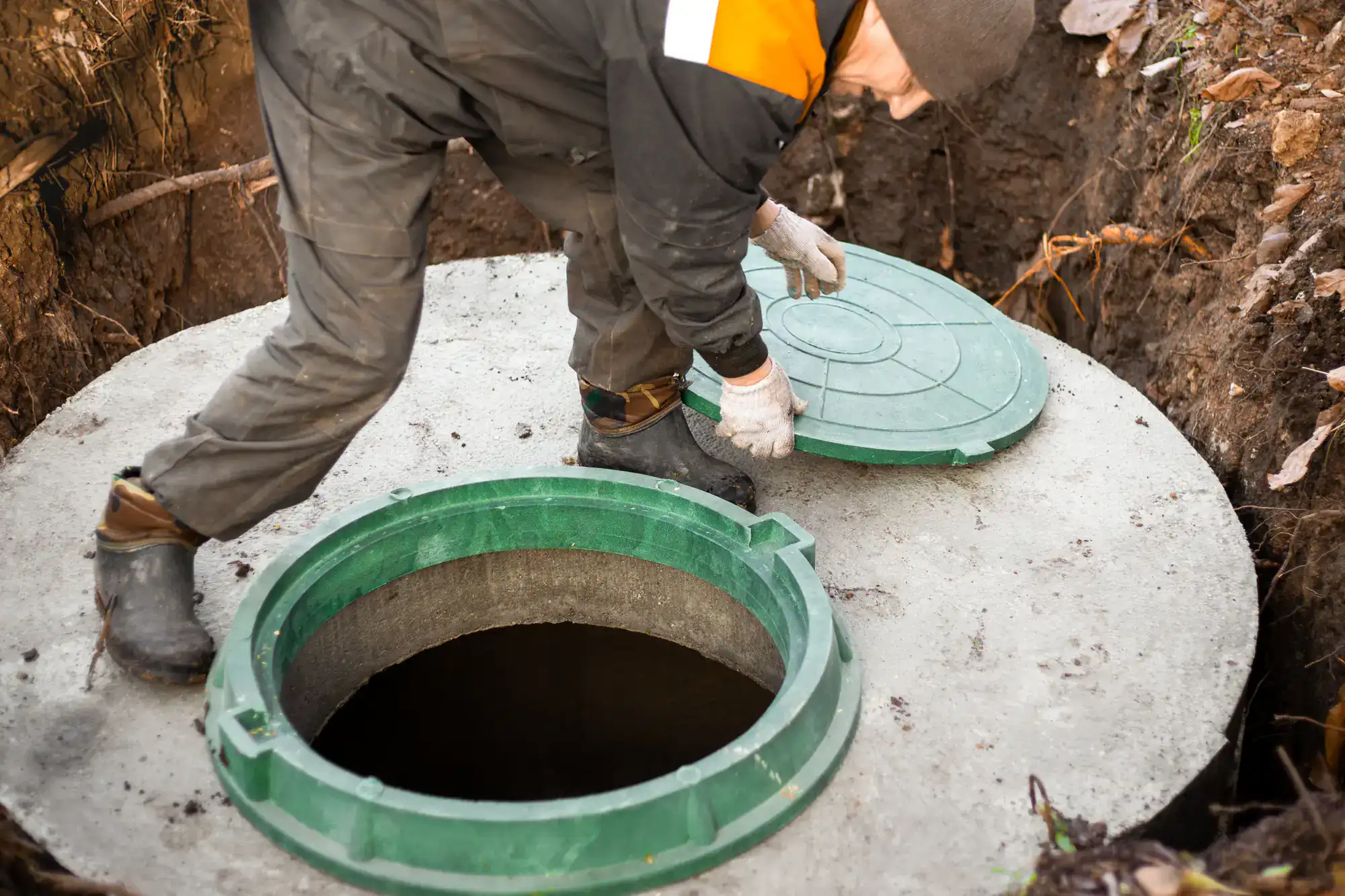
Once on-site, the first step is understanding what’s actually happening underground. For Lloyd Harbor properties — many of which were built in the 1950s and 1960s and have large, multi-chamber systems that may have no visible access point — we often use a waterproof camera to inspect the pipes before any digging starts. This matters on a two-acre-plus estate where excavating in the wrong place is a real disruption. The camera gives a clear picture of which chamber needs attention, where a blockage is located, and whether the system is structurally sound. It’s targeted, not guesswork.
From there, the work is completed — whether that’s a routine pump-out, a leaching pool service, a main line cleaning, or something more involved. If the system requires replacement and triggers Suffolk County’s IA system requirement, that conversation happens transparently, including what the 2024 county reimbursement program may cover. After the job, you’ll know exactly what was done, what the system’s current condition is, and what the recommended service interval looks like going forward.

Ready to get started?
We handle the full scope of cesspool and drainage services — which matters in Lloyd Harbor, where the systems are often older, larger, and more complex than what you’d find in a standard Suffolk County neighborhood. Cesspool cleaning and pumping, leaching pool service, cesspool installation, video pipe inspection, drywell cleaning, house trap replacements, main sewage line cleaning and replacement, storm drain cleaning, and cesspool location are all handled in-house.
The cesspool location service is worth calling out specifically. Many Lloyd Harbor properties have systems installed in the 1950s and 1960s with no visible cover — and some current owners have never had the system located at all. On a large estate, that’s not a minor inconvenience. We specialize in finding systems with no visible access point, which is the necessary first step before any meaningful inspection or service can happen.
Real estate certifications are also available in-house. In a village where homes regularly transact at $1.5M, $2M, and above, the cesspool inspection and certification required for a property transfer is a high-stakes document. It needs to be accurate, complete, and meet mortgage lender requirements. Beyond that, Lloyd Harbor homeowners are also subject to Suffolk County’s three-year inspection requirement and the EPA and NYSDEC compliance layer that comes with living adjacent to designated protected water bodies — including Huntington Bay and the waters of the Huntington-Northport Bay Complex. We understand that regulatory environment and work within it.