Useful Links
Other Services we provide in Commack
For most Commack homeowners, every one to three years is the right target and if your home was built in the 1950s or 1960s, lean toward the shorter end of that range. Older single-chamber cesspools fill faster than modern septic systems because they handle both liquid and solid waste in a single chamber without the separation that newer designs provide.
Commack’s soil is sandy and highly permeable, which helps with drainage under normal conditions. But when the water table rises after heavy rain and northern Suffolk County has seen significant flooding events in recent years, including widespread cesspool backups during the August 2024 storms that permeability works against you. A saturated water table reduces the system’s ability to drain, which means even a system that isn’t full of solids can start backing up. Staying on a regular pumping schedule means your system has the capacity to handle those pressure events without failing.
If you’ve recently purchased an older Commack home and don’t have documentation of the last service, don’t try to guess just schedule a pump-out and get a baseline. It’s the only way to know what you’re actually working with.
For a standard residential pump-out in Suffolk County, the typical range is $200 to $500. Where you land within that range depends on a few things: the size of your tank, whether the cover is easily accessible or needs to be located and dug up, how much has accumulated since the last service, and whether the job is scheduled in advance or called in as an emergency.
In Commack, the most common variable that pushes cost upward is access. In homes built in the 1950s and 1960s, cesspool covers are frequently buried under years of landscaping, and there’s often no documentation of where the system is located. Locating and exposing a buried cover adds time to the job, which affects the final cost. That’s not a hidden charge it’s a real factor in older homes, and any honest company will tell you upfront that it may apply.
Emergency service, when the system is actively backing up or causing property damage, will cost more than a scheduled pump-out. The way to avoid emergency pricing is straightforward: don’t wait until there’s a problem to call.
The clearest sign is slow drains throughout the house not just one fixture, but multiple. When your kitchen sink, bathroom drains, and toilet are all sluggish at the same time, that’s the system telling you it’s running out of capacity. A sewage smell coming from your drains or from the area of your yard where the system is located is another hard-to-ignore signal.
Standing water or unusually lush, green patches of grass over the cesspool area can indicate that the system is saturated and leaching to the surface. Gurgling sounds from your toilet when you run water elsewhere in the house are also a warning sign that’s air being displaced by a system under pressure.
In Commack, one scenario that catches homeowners off guard is the post-storm backup. After a significant rain event, the water table in central Suffolk County can rise enough to push effluent back toward the surface even in a system that isn’t full of solids. If your drains slow down or back up after heavy rain, don’t assume the system is fine once the rain stops get it checked.
This is more common in Commack than most people realize. The community’s post-war housing boom happened fast thousands of homes went up in a short window, and the cesspool documentation from that era is inconsistent at best. If the home changed hands a few times over the decades, the records may simply not exist or may not have been passed along at closing.
The first step is to call a company that specifically handles hard-to-find cesspools this is something we’ve built a direct specialty around. Using a combination of probing and knowledge of how systems were typically installed in homes of that era and construction type, our technicians can locate the system without tearing up the entire yard.
Once it’s located, you mark it and document it. Going forward, you’ll know exactly where it is, and you’ll have a service record starting from that point. For a new homeowner in Commack, that baseline pump-out and location documentation is one of the most practical things you can do in the first year of ownership especially if you ever plan to sell.
The majority of Commack is not connected to a municipal sewer system. Like most of central and eastern Suffolk County, the community relies on onsite wastewater systems primarily cesspools in the older housing stock, with some newer or upgraded properties using conventional septic tanks or, more recently, Innovative/Alternative Onsite Wastewater Treatment Systems.
This matters for a few reasons. Without sewer infrastructure, every home is responsible for managing its own waste treatment on the property. That means the condition of your cesspool directly affects your property’s functionality, your home’s value, and because Suffolk County sits entirely on a sole-source aquifer with no backup water supply the quality of the groundwater that flows from every tap in the community. There is no municipal water treatment buffer between a failing cesspool and the drinking water supply here.
Suffolk County banned new conventional cesspool installation in 2019, so any system that fails and needs full replacement must be upgraded to an I/A OWTS system. Understanding that your home depends on its onsite system and that replacement is expensive is the clearest reason to maintain what you have.
They’re related but not the same, and the difference matters more than most homeowners realize. Pumping removes the liquid waste and floating solids from the tank it’s the standard service that keeps the system from overfilling and is what most people schedule on a routine basis. Cleaning goes further: it involves a more thorough removal of hardened sludge from the walls and bottom of the tank, often combined with an inspection of the system’s structural condition.
For a Commack home with a cesspool that’s been on a regular service schedule, routine pumping is typically sufficient to keep the system healthy. But if the system hasn’t been serviced in several years or if you’ve just bought an older home with no service history a more thorough cleaning and inspection gives you a real picture of what you’re working with. In a 60-year-old cesspool, the difference between “needs pumping” and “has a structural problem developing” isn’t always obvious from the outside.
We perform thorough clearing and sewer inspection services as part of our drain cleaning work, so if there’s any uncertainty about the system’s condition, you’re not just getting a surface-level answer.
Hear from Our Customers

The most immediate thing you notice is that the problem stops getting worse. Slow drains clear up. The faint smell that’s been hanging around the yard disappears. You stop mentally filing it under “I’ll deal with that eventually” and move on with your week.
For Commack homeowners specifically, there’s more at stake than convenience. About 73% of the housing stock here was built between the 1940s and 1960s which means the cesspool under your property is likely somewhere between 55 and 75 years old. Systems that age don’t give you a lot of warning before they shift from “working” to “failing.” Regular pumping is what keeps that gap from closing on you without notice.
There’s also the equity angle. Median home values in Commack run from the mid-$600,000s into the high $800,000s. When you’re sitting on that kind of asset, a cesspool that backs up during a showing or fails a pre-sale inspection isn’t a minor inconvenience it’s a direct hit to your negotiating position. Buyers’ attorneys ask for service records. Having them is a small thing that protects a very large investment.
We’re a family-owned operation based in West Babylon, and Commack sits squarely in the territory we’ve been working for over three decades. The route up the Sagtikos State Parkway to the Northern State Parkway is a familiar one this isn’t a company stretching its service area to claim your zip code.
What that experience actually means is familiarity with the specific conditions that affect cesspool systems in central Suffolk County: the sandy, highly permeable soil, the water table behavior after heavy rain, and the aging single-chamber systems that dominate the pre-1973 housing stock throughout Commack. We’ve also dealt with the split-town reality here properties in the northern part of Commack fall under the Town of Huntington, while the southern portion sits in the Town of Smithtown. When a job escalates beyond a routine pump-out, knowing which town office handles permits matters.
The technicians who show up George, Mike, and Lucas are names that appear repeatedly in customer reviews are the people doing the work. Not subcontractors. Not whoever’s available. The same crew that answers the phone is the crew that comes out.
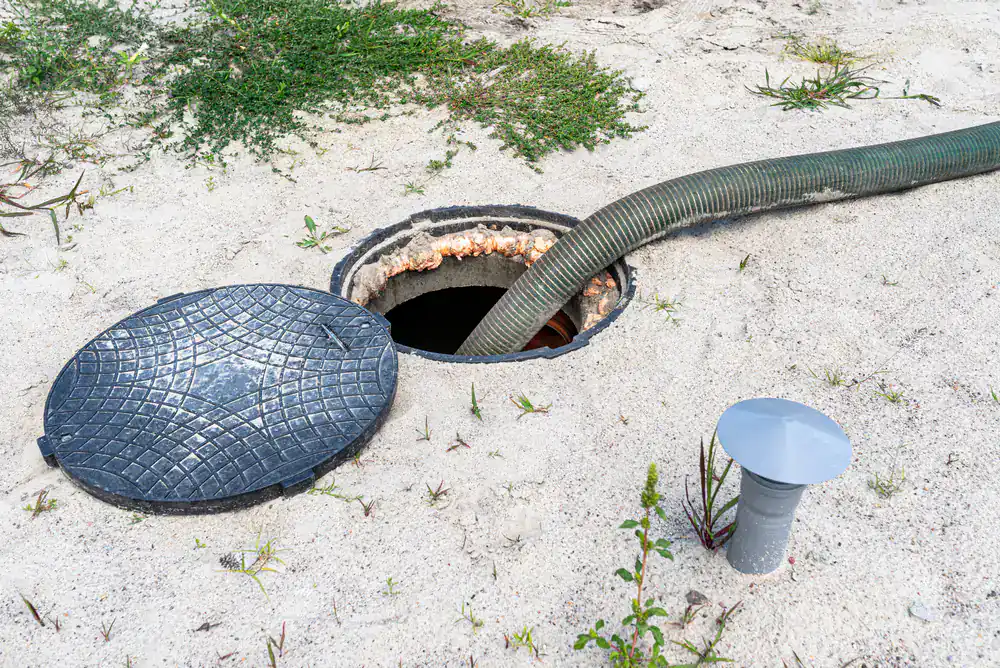
It starts with a call. A real person picks up not voicemail, not a callback form and gives you a straight answer on timing and what to expect. That’s not a small thing in this industry, and it’s something our customers specifically call out in their reviews.
When our technician arrives, the first order of business is locating the access point. In a community where most homes were built in the 1950s and early 1960s, cesspool covers are sometimes buried, unmarked, or documented only in paperwork that changed hands three owners ago. We’ve built a specific reputation around finding hard-to-locate systems in Commack if you don’t know where yours is, that’s a solvable problem, not a reason to delay service.
Once access is confirmed, we pump the tank fully. That means liquid waste, floating solids, and accumulated sludge not just a partial draw that gets the system functional for another few months. After the pump-out, you get written documentation of the service. In Commack’s real estate market, that paperwork has real value at closing. If our technician observes anything during the service that warrants attention a structural concern, a cover that needs replacement, a system showing signs of wear you’ll hear about it clearly, without pressure.

Ready to get started?
For a standard residential pump-out in Suffolk County, the typical range runs $200 to $500 depending on tank size, how accessible the cover is, and how much has accumulated since the last service. Most Commack homes fall within that range for routine maintenance. Emergency service when the system is actively backing up or a sinkhole has appeared commands a higher rate, which is why staying ahead of the schedule matters.
How often you need service depends on the system and the household. For older single-chamber cesspools like those found throughout Commack’s post-war housing stock, every one to three years is a realistic target. Larger households fill systems faster. If you’ve bought an older home and have no service history to reference, the right move is to start fresh with a baseline pump-out and go from there.
One thing worth knowing: Suffolk County banned new conventional cesspool installation in 2019. That means if a system in Commack reaches the end of its life and needs full replacement, it has to be replaced with an Innovative/Alternative Onsite Wastewater Treatment System a process that runs $20,000 to $40,000 or more. That’s the real cost of letting an aging system go unserviced. Routine pumping at $200 to $500 per cycle isn’t maintenance spending it’s the most cost-effective way to extend the life of a system that can’t be cheaply replaced.