Useful Links
Other Services we provide in Fort Salonga
It can, yes and it’s worth understanding why before you get a quote. Clay soil drains significantly more slowly than the sandy soil found in southern and eastern parts of Suffolk County. When we run a perc test on a Fort Salonga property and get a slow result, that affects how the drain field needs to be designed. In some cases, a larger drain field footprint is required to compensate for the slower absorption rate. In others, an I/A OWTS system which treats effluent to a higher standard before dispersal is a better fit because it reduces the burden on the surrounding soil.
This doesn’t automatically mean your installation will be the most expensive scenario, but it does mean that a proper site assessment matters more here than it would in a sandier area. Any quote from us is based on what we actually find at your property not a number pulled from a general price range.
No not since July 1, 2019. Suffolk County banned new cesspool-only installations on that date, which means any replacement system must meet modern septic standards at minimum. A conventional cesspool a simple pit that allows raw waste to seep into surrounding soil without any treatment is no longer a legal replacement option anywhere in Suffolk County, including Fort Salonga.
What replaces it depends on your property. At minimum, you’re looking at a septic tank with a leach field. In many cases, especially for Fort Salonga properties near the Crab Meadow Watershed or Long Island Sound, an I/A OWTS nitrogen-reducing system is the appropriate choice and may be required depending on your property’s specific circumstances. The good news is that I/A OWTS systems are what the Suffolk County Septic Improvement Program grant covers, so if your property qualifies, the upgrade that meets the highest standard may also be the most financially accessible one.
Fort Salonga properties in Suffolk County are generally eligible for the Septic Improvement Program, which as of July 2025 offers combined State and County grants of up to $45,000 toward the cost of an I/A OWTS installation. Given that a full septic system replacement in Suffolk County typically runs between $20,000 and $40,000, this grant can cover the majority or the entirety of your project cost.
There are a few things to understand about how the grant works. First, you need to apply and receive grant approval before installation begins. The grant cannot be applied retroactively after the work is done. Second, the installation must be performed by a contractor on the SIP approved installer list not just any licensed septic contractor. Third, the grant funds are assigned directly to the installer, not reimbursed to you after the fact. This means the process works best when your contractor is familiar with the program and can help you navigate the application steps before scheduling the work.
A home built in the 1950s in Fort Salonga almost certainly has an original cesspool that is now somewhere between 65 and 75 years old. The typical functional lifespan of a conventional cesspool is 20 to 30 years. That alone is a strong indicator that a professional assessment is overdue, regardless of whether you’re noticing any obvious symptoms.
The challenge with aging cesspools especially in Fort Salonga’s clay-rich soil is that failure doesn’t always announce itself clearly. You might not see sewage backing up into the house or wet patches in the yard until the system has already been struggling for some time. Slow drains, occasional sewage odors near the yard, or a system that needs pumping more frequently than it used to are all early warning signs worth taking seriously. A site visit and assessment gives you a clear picture of where your system actually stands and whether you’re dealing with something that can be maintained or something that needs to be replaced before it becomes an emergency on someone else’s timeline.
The active installation work itself excavation, installation, abandonment of the old system typically takes one day for most residential properties. That’s the part that happens in your yard. What takes longer is the process that has to happen before the crew arrives.
Before any installation can begin, the Suffolk County Department of Health Services requires a permit or registration filing under Article 6 of the Suffolk County Sanitary Code. If a perc test is needed first, that adds additional time before the permit application can even be submitted. Once the application is in, permit review timelines can add a few weeks depending on current volume at SCDHS. If you’re also going through the SIP grant process, that application needs to be approved before installation begins, which adds another step to the front end. The full timeline from first call to completed installation accounting for site assessment, perc testing if needed, permitting, and scheduling is typically several weeks. Starting the process before your system is in crisis gives you the most control over that timeline.
For the septic permit itself, no all septic and cesspool work in Fort Salonga falls under Suffolk County Department of Health Services jurisdiction regardless of which side of the town line your property sits on. Article 6 of the Suffolk County Sanitary Code applies uniformly across both the Town of Huntington portion and the Town of Smithtown portion of Fort Salonga.
Where the dual-town situation can create confusion is with ancillary contacts and municipal processes that aren’t handled at the county level. A contractor who doesn’t know Fort Salonga well may not immediately know which town’s building department or records office is relevant to your property, which can slow things down if questions come up during the process. It’s a small thing, but it’s the kind of thing that adds unnecessary friction when a contractor is working in an unfamiliar area. We serve both Huntington and Smithtown, and we’re familiar with the jurisdictional geography of communities like Fort Salonga that don’t fall neatly into one municipal box.
Hear from Our Customers
Most homeowners don’t think about their septic system until something goes wrong. By then, the options get more expensive and more disruptive. Getting ahead of it especially in a community like Fort Salonga means you’re making a decision on your terms, not under pressure.
Fort Salonga’s soil is famously clay-rich. That’s the same geology that fueled a brickmaking industry here in the 19th century, shipping “Salonga brick” by barge from Duck Island Harbor to New York City. That red clay is still under every yard in the hamlet today. Clay drains slowly, and when a cesspool sits in clay-heavy ground for decades, absorption capacity drops quietly often without any obvious sign above ground. A properly designed septic system, sized for what’s actually in your soil, stops that slow failure before it becomes an emergency.
The other reality here is proximity to water. Fort Salonga sits directly on Long Island Sound, and the Crab Meadow Watershed runs through the community. The nitrogen leaching from aging cesspools in this hamlet has a short path to Northport Bay. A modern I/A OWTS system reduces that nitrogen output by up to 70% compared to a conventional cesspool which means the water quality at Crab Meadow Beach is directly tied to what’s happening underground on your property. That’s not a distant environmental argument. That’s your beach.
We’re a family-owned company based in West Babylon, serving all of Nassau and Suffolk Counties including the full stretch of western Suffolk that takes you up through Huntington and Smithtown, the two towns that split Fort Salonga right down the middle. That dual-town jurisdictional quirk is something a lot of contractors aren’t prepared for. We are.
Over 30 years of hands-on experience on Long Island means we’ve worked properties across the North Shore the clay soils, the coastal setback requirements, the Suffolk County Department of Health Services permitting process. We know what a perc test looks like when the ground is slow. We know which side of a town line affects which contacts. And we know that a homeowner in Fort Salonga with a home built in 1958 and an original cesspool is in a different situation than someone in a newer build further south.
When you call us, a real person picks up. When we give you a time, we show up at that time. That’s not a promise we make lightly it’s what our customers say about us, by name, in reviews.
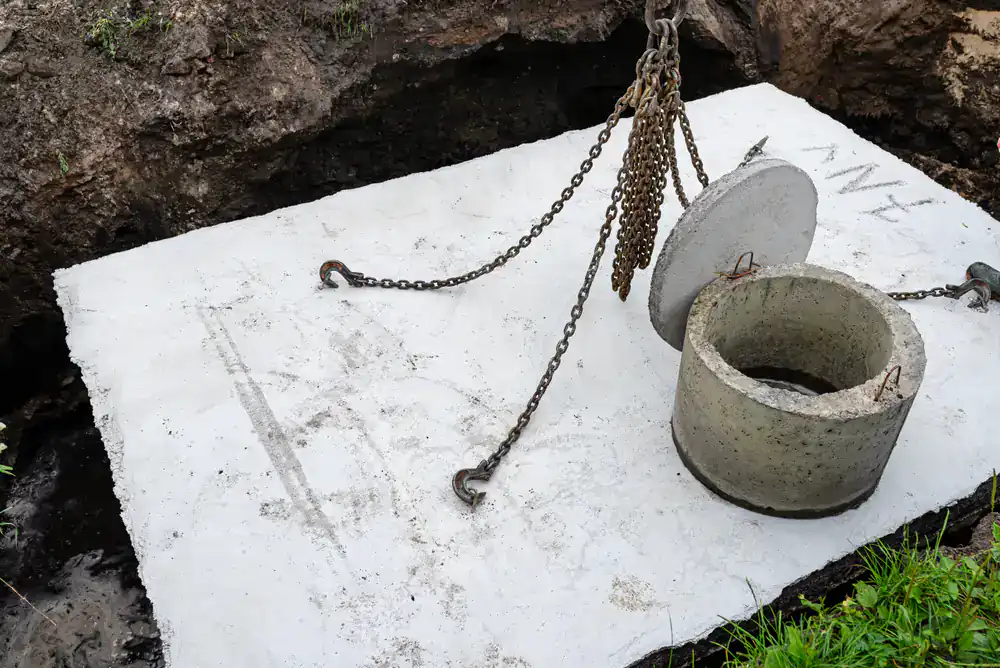
It starts with a site visit. Before anything else, we come out to assess your property the existing system, the soil conditions, the layout of your lot. For Fort Salonga properties, that means paying close attention to clay content and groundwater levels, both of which affect how a new system needs to be designed and where it can be sited. If a perc test is needed to confirm soil drainage rates, we coordinate that as part of the process.
Once we have a clear picture of what your property needs, we put together a written estimate specific to your site, not a ballpark pulled from a price sheet. From there, we handle the permit filing with the Suffolk County Department of Health Services under Article 6 of the Suffolk County Sanitary Code. This is a required step before any installation work begins, and it applies whether your property falls on the Huntington side or the Smithtown side of Fort Salonga. Permit timelines vary, but we keep you informed at every stage so you’re not left wondering.
When permits are in hand, most residential installations are completed in a single day of active work. We handle the excavation, installation, proper abandonment of the old system, and all required documentation. After the work is done, we provide full installation records something you’ll want on hand for any future property sale, especially in a real estate market as active as the Northport-East Northport school district corridor.

Ready to get started?
Suffolk County banned new cesspool-only installations as of July 1, 2019. That means if your current system needs to be replaced, it’s going up to modern septic standards at minimum and depending on your property’s location and use, an I/A OWTS nitrogen-reducing system may be required or strongly advisable. For Fort Salonga properties near the Crab Meadow Watershed and Long Island Sound, the case for I/A OWTS is both regulatory and practical.
We install septic systems designed for the specific conditions on your property. That means accounting for Fort Salonga’s clay-heavy soil, the coastal setback requirements that apply near Long Island Sound (100 feet from water wells, 20 feet from property lines under Suffolk County environmental standards), and the size and layout of your lot. One-to-two-acre lots give more flexibility for drain field placement than the smaller lots you’d find in denser parts of Suffolk County but clay soil can still require a larger drain field footprint or an alternative system configuration to perform correctly.
If you’re pursuing the Suffolk County Septic Improvement Program, the grant must be applied for and approved before installation begins and the work must be completed by an SIP-approved installer. As of July 2025, combined State and County grants of up to $45,000 are available for eligible I/A OWTS installations. Given that a full septic system replacement in Suffolk County typically runs between $20,000 and $40,000, that grant can cover most or all of your project cost. We can walk you through what the application process looks like and what’s required on your end before work begins.