
Septic monitoring technology is reshaping how Sayville homeowners manage their systems. Here's what it is, how it works, and why it matters more in Suffolk County than almost anywhere else.
Most Sayville homeowners don’t think about their septic system until something forces them to. A slow drain, a smell coming from the yard, or a neighbor’s horror story about a backup. That’s usually what kicks off the conversation. And by that point, you’re already behind.
The good news is that the septic industry is finally catching up with the rest of home technology. Smart monitoring is making it possible to stay ahead of problems instead of reacting to them. Here’s what that actually looks like, why it matters more in Suffolk County than most people realize, and how it changes the way we think about septic system pumping.
Smart septic monitoring uses IoT-connected sensors installed on your tank to track what’s happening inside it in real time. These sensors measure liquid levels, flow activity, and in some cases equipment operation, then send that data to a cloud-based dashboard you can check from your phone. Instead of waiting for a symptom to appear, you get an alert when your tank reaches a threshold that warrants attention.
The sensors take readings continuously, some systems measure every five to thirty minutes, which adds up to as many as 288 data points per day. Compare that to zero measurements between manual inspections, which for most homeowners means years of complete unknowns. That’s the core shift: from guessing to knowing.

The measurement frequency is one of the things that surprises people most when they first learn about this technology. A sensor checking your tank every five to thirty minutes isn’t just a novelty. It’s a fundamentally different way of understanding your system’s behavior over time.
You start to see patterns: how a weekend with a full house affects fill levels, how a heavy rainstorm changes things, how your usage compares week to week. Most residential smart monitoring systems track liquid levels as the primary metric, but more advanced setups also monitor flow activity and whether mechanical components like pumps are operating correctly. That broader picture matters because a tank at 60% capacity with a malfunctioning pump is a very different situation than a tank at 60% with everything running normally.
Many of these systems also integrate with smart home platforms, including Alexa and Google Home, so your cesspool status can sit alongside your thermostat and security cameras in the same dashboard you’re already checking. Battery backup keeps the sensors running during power outages, which is worth noting, because storms that knock out power on Long Island are also the storms dumping rain that raises the water table and accelerates fill rates in South Shore cesspools.
The global market for smart septic monitoring reached $1.12 billion in 2024 and is projected to grow at a 13.7% annual rate through 2033. This isn’t a fringe category anymore. It’s a rapidly mainstreaming part of how homeowners manage their properties.
The three-year pumping rule exists because it works reasonably well for the average household with the average tank and the average usage pattern. The problem is that very few Sayville homes fit neatly into that average.
Older single-chamber cesspools, common in the neighborhoods between Montauk Highway and the bay, where many homes were built before Suffolk County began formally regulating cesspool construction in 1973, often need service every one to three years, not three to five. A home that hosts summer guests traveling to Fire Island can see its system stressed far beyond what a fixed schedule accounts for.
Smart monitoring doesn’t replace pumping. It replaces the guesswork about when pumping is actually needed. For some homes, that means catching a problem sooner than the calendar would have flagged it. For others, it means confirming that the system is genuinely fine and the pump-out can wait, which saves money and avoids unnecessary service calls.
There’s also a documentation benefit that tends to get overlooked. Approximately 63% of homeowners don’t know where their septic tank is located. A professionally installed monitoring system creates a documented record of system location, capacity, and condition history. In Suffolk County’s active real estate market, that kind of documentation has real value, cesspool certifications are increasingly expected before a sale closes, and a system with a clear maintenance history is a much easier conversation than one with no records at all.
Smart monitoring makes your septic system pumping schedule smarter. It doesn’t eliminate the need for maintenance, it just ensures you’re doing it at the right time, based on what’s actually happening inside your tank rather than what a generic rule of thumb predicts.
Want live answers?
Connect with a Drastic Drainage expert for fast, friendly support.
Smart monitoring is useful anywhere, but it’s especially valuable in Suffolk County for reasons that have nothing to do with technology trends. The local regulatory environment, the geography of the South Shore, and the age of the housing stock all combine to make proactive septic maintenance a financial priority here in a way that doesn’t apply in most other markets.
Understanding that context is the difference between treating smart monitoring as a convenience and treating it as the risk management tool it actually is for Sayville homeowners.
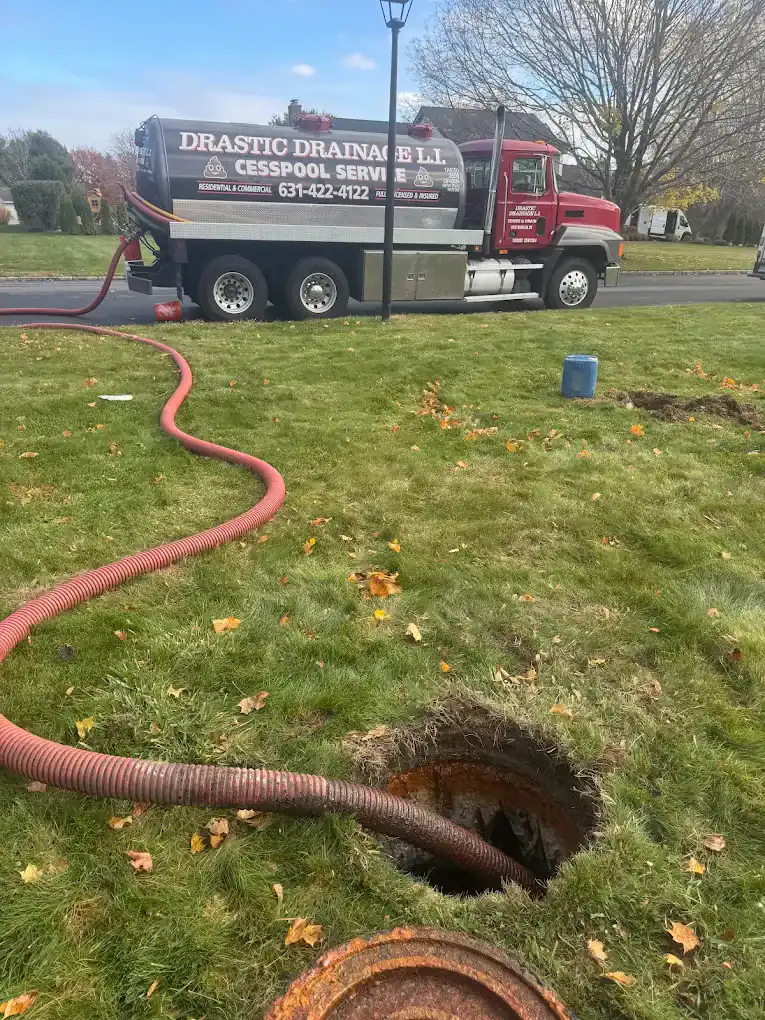
In July 2019, Suffolk County amended its Sanitary Code to eliminate the option of replacing a failed cesspool with another cesspool. Before that change, a failing system could be swapped out in kind, same type, similar cost. That option no longer exists.
Today, any cesspool that fails and requires replacement must be upgraded to at minimum a conventional septic system with a tank and leaching structure, or in many cases an Innovative and Alternative Onsite Wastewater Treatment System, known as an I/A OWTS, designed to reduce nitrogen output by up to 70%.
The cost of that upgrade runs between $19,000 and $25,000. That’s not a worst-case estimate. That’s the range homeowners in Suffolk County are actually facing when a system fails under the current regulatory framework. Routine septic system pumping, by contrast, runs $300 to $600. That’s the entire cost of staying ahead of the problem.
Smart monitoring is what ensures you actually do stay ahead of it, catching deteriorating conditions at 70% or 80% capacity, when a pump-out solves the problem, rather than at the point of failure, when the only option is a five-figure replacement. The Suffolk County Septic Improvement Program, known as SHIP, does offer grant funding that can offset a significant portion of I/A OWTS installation costs. But even with grant assistance, the disruption, permitting timeline, and landscaping restoration involved in a full system replacement make it a situation worth avoiding if you can.
Sayville sits on Suffolk County’s South Shore, directly along the Great South Bay. That location shapes everything about how residential septic systems behave here. The water table is close to the surface, influenced by tidal and seasonal fluctuations from the bay.
During heavy rain events, the kind that aren’t unusual on Long Island’s South Shore, the soil’s ability to absorb cesspool effluent decreases significantly, and fill rates can accelerate faster than a standard calendar-based schedule would anticipate. The housing stock adds another layer of complexity. Many Sayville homes, particularly those in the older neighborhoods closer to the water, were built before modern construction standards and before Suffolk County began formally regulating cesspool systems. These homes often have single-chamber cesspools with no maintenance records, buried access lids, and unknown configurations.
They require service more frequently than newer systems, and they’re more sensitive to the kind of seasonal and weather-related stress that comes with living near the bay. Then there’s the seasonal population factor. Sayville is a departure point for Fire Island ferries, which means summer weekends can bring a significant increase in household occupancy for some properties. A system sized for a typical household load can be pushed well beyond its normal parameters during those months, and a fixed pump schedule has no way of accounting for that.
Real-time monitoring addresses all three of these factors simultaneously. It doesn’t matter whether the elevated fill level is coming from a rainy week, a full house of summer guests, or a system that’s simply older and less efficient than it used to be. The sensor sees the fill level rising and alerts you. You call us, we come out, and the problem gets handled before it becomes a failure.
We’ve been working on Long Island’s septic and cesspool systems for over 30 years. We know what older Sayville systems look like, we know how the South Shore water table behaves, and we know the difference between a system that needs attention now and one that’s fine for another season. When a monitoring alert comes in, that kind of local knowledge is what turns the data into the right decision.
If your home has an older cesspool, sits close to the bay, or sees any kind of seasonal occupancy increase, the answer is almost certainly yes. The technology has matured, the costs are reasonable relative to what it protects against, and the stakes in Suffolk County, with a mandatory five-figure replacement on the line if a system fails, make proactive monitoring a straightforward decision rather than a luxury.
The shift isn’t complicated. You go from guessing about your system’s condition to knowing it. You go from reacting to problems to catching them early. And you go from a generic pump schedule that was designed for the average household to a maintenance approach that’s based on what’s actually happening inside your specific tank.
If you have questions about your system, want to understand what monitoring might look like for your property, or simply need septic system pumping scheduled, reach out to Drastic Drainage Long Island. We’re a local business, we answer the phone, and we’ll give you a straight answer about what your system actually needs.
Summary:


Article details:
Share: