Useful Links
Other Services we provide in West Hills
West Hills has no public sewer infrastructure. Like the vast majority of Suffolk County, every home in West Hills manages wastewater through an onsite system a cesspool, a conventional septic system, or an I/A OWTS advanced treatment unit. There is no municipal sewer alternative available, which means that when an onsite system fails or reaches the end of its service life, replacement is the only path forward.
This is worth understanding clearly if you’re newer to West Hills or moved from a part of New York where public sewer was standard. The system under your property is entirely your responsibility to maintain, repair, and eventually replace. Suffolk County’s regulatory framework governs what kind of system can be installed and who is licensed to do the work, but the county doesn’t handle the installation itself. That falls to a licensed contractor holding a Suffolk County Liquid Waste License a credential that’s separate from a general plumbing license and specific to this type of work.
A cesspool is essentially a pit. Raw wastewater flows in, liquids seep out into the surrounding soil, and solids accumulate at the bottom. There’s no treatment happening just containment and slow dispersal. Most of the homes built in West Hills in the 1950s and 1960s were built with cesspools, which were standard practice at the time. After 60-plus years of use, many of those systems are well past their functional lifespan.
A septic system is different. It separates solids from liquids inside a tank, allows the liquid effluent to flow to a leaching field for further treatment in the soil, and produces a meaningfully cleaner output than a cesspool does. An I/A OWTS system goes further still it uses advanced treatment technology to reduce nitrogen in the effluent by up to 70% before it reaches the soil. That distinction matters both environmentally and legally: Suffolk County banned new cesspool installations in 2019, so any replacement in West Hills today has to meet septic or I/A OWTS standards. If you’re in West Hills and your cesspool was installed when the neighborhood was built, you’re likely looking at a full replacement, not a repair.
The honest answer is that cost varies significantly depending on the type of system, the specific conditions of your property, and what the soil evaluation reveals. A conventional septic system replacement in Suffolk County generally runs in the range of $20,000 to $40,000. An I/A OWTS installation the advanced nitrogen-reducing system now required in many replacement scenarios typically comes in around $25,000 on average, though site-specific factors can move that number in either direction.
Before any of that, there are pre-installation costs to account for: a soil percolation test typically runs $500 to $1,500, and SCDHS permits generally cost $200 to $500 depending on system size. These aren’t optional they’re required steps in the process. The good news for West Hills homeowners is that the Suffolk County Septic Improvement Program offers up to $45,000 in combined state and county grants for eligible I/A OWTS installations as of July 2025, which can significantly offset the total out-of-pocket cost. The key is applying before installation begins not after.
The active installation work excavation, system installation, and site restoration typically takes one to three days for a residential property. That’s the part most homeowners are focused on, and for good reason: nobody wants their yard torn up for weeks. For properties in West Hills with established landscaping and half-acre-plus lots, professional excavation and site restoration are part of what you’re paying for.
What takes longer is the permitting phase that comes before the physical work. The soil evaluation and perc test need to be completed first, and then the SCDHS permit application has to be filed and approved before any installation can begin. That process typically adds a few weeks of lead time, sometimes longer depending on current application volumes at the county. If your system is already failing or showing signs of stress slow drains, wet patches in the yard, sewage odors that timeline is worth factoring into your planning sooner rather than later. Spring in West Hills, when snowmelt saturates the ground around aging cesspools, tends to be when homeowners realize they’ve waited too long.
Yes West Hills is in Suffolk County, Town of Huntington, so the Suffolk County Septic Improvement Program applies fully. The SIP offers eligible homeowners up to $45,000 in combined state and county grant funding for the installation of an I/A OWTS nitrogen-reducing system. There are eligibility requirements: the property needs to have a valid certificate of occupancy, no delinquent property taxes, and the existing system needs to be a cesspool or conventional septic that doesn’t meet I/A OWTS standards.
One thing that trips homeowners up is the timing. The grant certificate has to be issued before installation begins the program doesn’t work as a reimbursement after the fact. Grant funds are also assigned directly to the approved installer, not paid out to the homeowner to distribute. This means working with a contractor who is on the SIP approved installer list is a requirement, not just a preference. West Hills sits right on the Nassau/Suffolk county line near Woodbury, so if you’ve seen references to Nassau County’s S.E.P.T.I.C. program, that one doesn’t apply here you’re in Suffolk County, and the SIP is the relevant program.
The old system doesn’t just get left in place it gets properly abandoned as part of the installation process. That means it’s pumped out completely, the structure is either crushed or filled with an approved material, and the abandonment is documented and recorded with the Suffolk County Department of Health Services. This documentation matters: it’s part of the official record for your property and becomes relevant any time you sell, refinance, or apply for permits on the property in the future.
For West Hills homeowners with older properties, this step sometimes reveals surprises unmarked or partially forgotten cesspools that weren’t on any record, or systems that are in worse condition than expected. That’s why a thorough site assessment before installation is worth doing carefully. Locating what’s actually underground before excavation begins saves time, cost, and the kind of mid-project discoveries that cause delays. We’ve worked on enough mid-century Long Island properties to know that what’s on the original survey doesn’t always match what’s in the ground, and we account for that from the start.
Hear from Our Customers

When a properly installed septic system replaces a decades-old cesspool, you stop managing a liability and start owning a documented, compliant piece of infrastructure. No more wondering whether the system will hold through another wet spring. No more hoping a buyer’s inspector doesn’t flag it. You know what’s underground, you have the paperwork to prove it, and it’s built to Suffolk County’s current standards.
West Hills sits on the glacially formed moraine that creates Long Island’s highest terrain hilly, sloped ground with soil conditions that behave differently than the flat South Shore communities most generic contractors are used to. A properly evaluated and sited system works with that topography. One that isn’t designed for it creates problems that show up months later, not on installation day.
For homeowners in West Hills, where median property values exceed $1,000,000 and nearly every home is owner-occupied, a failing or undocumented system isn’t just an inconvenience. It’s a real threat to the asset you’ve spent decades building. Getting ahead of it on your timeline, with the right contractor is a different experience than being forced into it during a transaction.
We’re a family-owned company based in West Babylon, about 12 to 15 miles from West Hills. That proximity matters less than the experience: over 30 years of working Long Island’s specific soil conditions, navigating the Suffolk County Department of Health Services permit process, and handling the kind of mid-century cesspool infrastructure that defines homes throughout West Hills and the Town of Huntington.
The homes near Cold Spring Hills and along Round Swamp Road aren’t new construction. They’re established properties with aging systems on large lots exactly the profile we’ve been working with for decades. Our owner’s name is on every job, the technicians are the same people you’ll find praised by name in customer reviews, and the process doesn’t change based on who’s watching.
When you call, a real person picks up. When we give you an arrival window, we show up in it. That’s not a promise it’s the consistent pattern customers have noted across years of reviews.
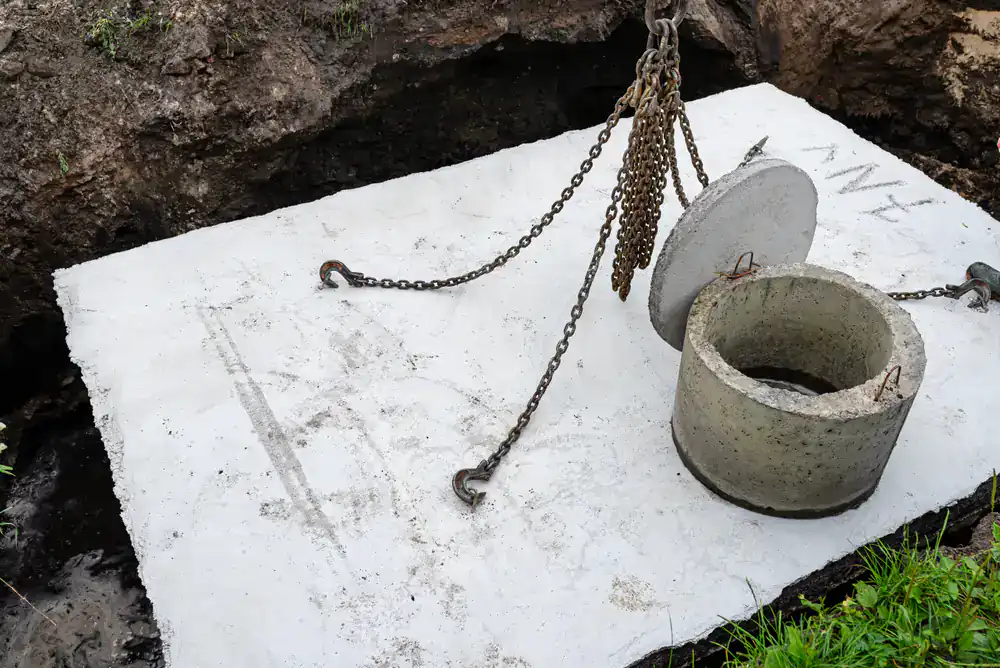
The process starts with a site assessment. Before any design decisions are made, the soil needs to be evaluated and a percolation test completed. In West Hills, where sloped lots and variable glacial till create site-specific drainage patterns, this step matters more than it does on flat terrain. The perc test results determine what kind of system your property can support and where the leaching field needs to go.
Once the soil evaluation is done, the design goes to the Suffolk County Department of Health Services for permitting. We understand this phase adds time before any physical work begins, and if your system is already struggling, waiting feels hard. The honest answer is that skipping the permit creates bigger problems: failed inspections, required re-excavation, and potential loss of grant eligibility. The permit process is the job, not a detour around it.
When permits are in hand, most residential installations in West Hills are completed in one to three days of active work. The old system gets properly abandoned pumped, documented, and filled and the new system is installed, inspected, and recorded. You receive installation documentation at the end, which matters when it comes time to sell or refinance.
Ready to get started?
Suffolk County banned new cesspool-only installations in July 2019. If you’re replacing a system in West Hills, the replacement has to meet modern septic standards at minimum and in many cases, depending on the scope of work, it needs to be an I/A OWTS system, which is the nitrogen-reducing advanced treatment technology now required for new construction and major reconstruction throughout Suffolk County.
This matters specifically for West Hills homeowners because the Suffolk County Septic Improvement Program the SIP offers eligible homeowners up to $45,000 in combined state and county grants for I/A OWTS installation as of July 2025. There’s a critical detail most homeowners don’t know: the grant has to be applied for and approved before installation begins. You can’t install the system and then apply for reimbursement. If you’re considering an upgrade, the sequence of steps matters, and working with us means you don’t accidentally lose funding you were entitled to.
West Hills properties are well-suited for I/A OWTS systems. The minimum half-acre lots throughout the hamlet’s main developments provide the physical space required for modern leaching fields, and the elevated terrain keeps most properties well clear of the groundwater concerns that complicate installations in lower-lying areas. We handle the full scope soil evaluation, permit filing, installation, and post-installation documentation so there’s a single point of contact and accountability throughout.