By submitting you consent to receive service-related texts from Drastic Drainage. Reply STOP to opt out. Msg & data rates may apply. Consent not required to book service.
Useful Links
A properly pumped septic tank means no slow drains, no sewage smell creeping into the yard, and no anxiety every time you flush. That peace of mind is what you’re actually paying for and it’s worth a lot more than the cost of a routine pump-out.
Port Jefferson’s housing stock is among the oldest on Long Island’s North Shore. A significant share of homes here were built before 1940, with many more from the 1950s and 1960s. The hillside neighborhoods above the harbor, the older estates in Belle Terre, and the mid-century homes throughout Port Jefferson Station all share the same reality: aging infrastructure that needs attention before it becomes an emergency.
When your system is running clean, you’re also doing your part for Port Jefferson Harbor. Nitrogen from neglected cesspools and septic tanks is the primary driver of algal blooms and declining water quality in Long Island’s bays and estuaries. Port Jefferson Harbor connects directly to Long Island Sound, so staying on top of maintenance isn’t just a home issue it’s a harbor issue.
The right interval depends on what type of system you have. Cesspools which are common in Port Jefferson’s older housing stock, particularly in homes built before 1973 when Suffolk County banned new cesspool construction typically need pumping every one to two years. Conventional septic tanks, which separate solids from liquids before dispersing effluent, generally need pumping every three to five years, though a household of four with a 1,000-gallon tank is often on a three to four year schedule.
Most Port Jefferson homeowners don’t know exactly when their system was last serviced, especially if they bought the home recently or inherited it. If you’re unsure, the safest move is to schedule a pump-out and inspection now rather than wait for a symptom to force your hand. A routine pump-out runs $300 to $600 in Suffolk County for standard residential systems. Waiting until the system backs up can turn that into a five-figure repair.
The most obvious signs are slow drains throughout the house not just one fixture, but multiple combined with gurgling sounds in the pipes, sewage odor near the tank or drain field area, and wet or unusually green patches of grass over the leach field. If you’re noticing water pooling in the yard without a recent rainstorm, that’s a strong indicator the system is saturated and struggling.
What most homeowners don’t realize is that by the time these symptoms appear, the system has usually been under stress for a while. In Port Jefferson, where a significant share of homes have older systems that may not have been serviced regularly, it’s more common than you’d expect to find a tank that’s well past capacity without any obvious warning signs. Don’t wait for a backup to confirm what a routine inspection would have caught months earlier.
This is one of the most common questions in the area, and the confusion is completely understandable. Suffolk County banned the construction of new cesspools in 1973, so if your home was built before that which applies to a large portion of Port Jefferson’s housing stock there’s a good chance you have a cesspool rather than a modern septic tank.
A cesspool is a single chamber that collects waste and allows liquid to seep into the surrounding soil without any separation process. A septic tank is a two-stage system that separates solids from liquids before dispersing effluent through a drain field. The practical difference matters because cesspools need more frequent pumping typically every one to two years and are more susceptible to failure as the surrounding soil becomes saturated over time.
If you genuinely don’t know which system you have, a service call from us will answer that question. Our technician can identify the system type, assess its condition, and give you a clear picture of what you’re working with before any work is done.
Standard residential septic tank pumping in Suffolk County runs $300 to $600 depending on tank size and access conditions. A 1,000-gallon tank typically falls in the $225 to $400 range; larger systems around 2,000 gallons run closer to $400 to $600. Those are the honest numbers for a straightforward pump-out with proper disposal at a licensed facility.
Where costs can climb and where some companies catch homeowners off guard is lid excavation. If your tank lid is buried under soil or landscaping, which is extremely common in Port Jefferson’s older properties, accessing it requires digging. That can add $300 to $1,200 to the job depending on how deep it is and how accessible the area is. We disclose these factors upfront before work begins, so the number you hear on the phone is the number you can plan around. There are no environmental disposal fees quietly added at the end or charges for work that wasn’t discussed.
The short version: a routine pump-out that costs a few hundred dollars becomes a drain field failure that costs $10,000 to $15,000 or more. When a tank goes too long without pumping, solids overflow into the leach field and clog the soil. Once the drain field is saturated and failing, pumping alone won’t fix it you’re looking at excavation, replacement, and potentially a full system upgrade.
In Suffolk County, the regulatory stakes are also higher than they used to be. Since 2019, in-kind cesspool replacement has been prohibited. If your system fails and needs to be replaced, you can’t simply swap in the same type of system you’re required to upgrade to at least a conventional septic system, and in some cases an Innovative/Alternative Onsite Wastewater Treatment system. For Port Jefferson homeowners in a high-value real estate market, an undocumented or neglected system isn’t just a maintenance issue it’s a liability that shows up at the worst possible time, usually during a sale.
Yes, and this comes up regularly in Port Jefferson. The village has a substantial share of homes built before modern septic documentation requirements existed some dating back to the 19th century shipbuilding era near the harbor. When a home changes hands without records, or when decades of landscaping have buried a lid entirely, locating the system is the first real challenge of any service call.
We specifically list cesspool location as a specialty, including systems that are hard to find. Our crew uses experience with Long Island’s older North Shore properties to locate tanks that other companies might give up on or charge excessively to access. If you’re in Belle Terre, Old Field, Poquott, or any of the older hillside neighborhoods above Port Jefferson Harbor and you genuinely have no idea where your tank is, that’s not a problem that ends the service call it’s just where the job starts.
Free, no-obligation estimates on cesspool, sewer, and drain work.
We get there quickly. No waiting days for a callback.
Backups don’t wait for business hours. Neither do we.
Fully licensed and insured across Long Island.
Up-to-date trucks and tools for cleaner, faster jobs.
Straight quotes, no surprises on the bill.
Hear from Our Customers
A properly pumped septic tank means no slow drains, no sewage smell creeping into the yard, and no anxiety every time you flush. That peace of mind is what you’re actually paying for and it’s worth a lot more than the cost of a routine pump-out.
Port Jefferson’s housing stock is among the oldest on Long Island’s North Shore. A significant share of homes here were built before 1940, with many more from the 1950s and 1960s. The hillside neighborhoods above the harbor, the older estates in Belle Terre, and the mid-century homes throughout Port Jefferson Station all share the same reality: aging infrastructure that needs attention before it becomes an emergency.
When your system is running clean, you’re also doing your part for Port Jefferson Harbor. Nitrogen from neglected cesspools and septic tanks is the primary driver of algal blooms and declining water quality in Long Island’s bays and estuaries. Port Jefferson Harbor connects directly to Long Island Sound, so staying on top of maintenance isn’t just a home issue it’s a harbor issue.
We’ve been handling cesspools and septic systems across Suffolk County for over 30 years, with deep roots in Port Jefferson and the surrounding North Shore communities. That experience is the difference between a technician who’s seen every variation of Port Jefferson’s older systems and one who hasn’t.
We know what a 1950s cesspool looks like, what a buried lid under 40 years of landscaping means, and how to handle a system that hasn’t been documented since the previous owners lived there. Our approach is straightforward: show up, assess honestly, pump thoroughly, and tell you exactly what your system needs nothing more.
We don’t recommend unnecessary work or charge high prices for simple tasks. Whether you’re in a historic home near Port Jefferson Harbor or a mid-century split-level off Route 25A, you get the same honest service.
It starts with a call. You describe what’s going on slow drains, a smell, a backup, or just a system that’s overdue and we give you a straight answer on what to expect, including cost, before anyone shows up. No surprises at the door.
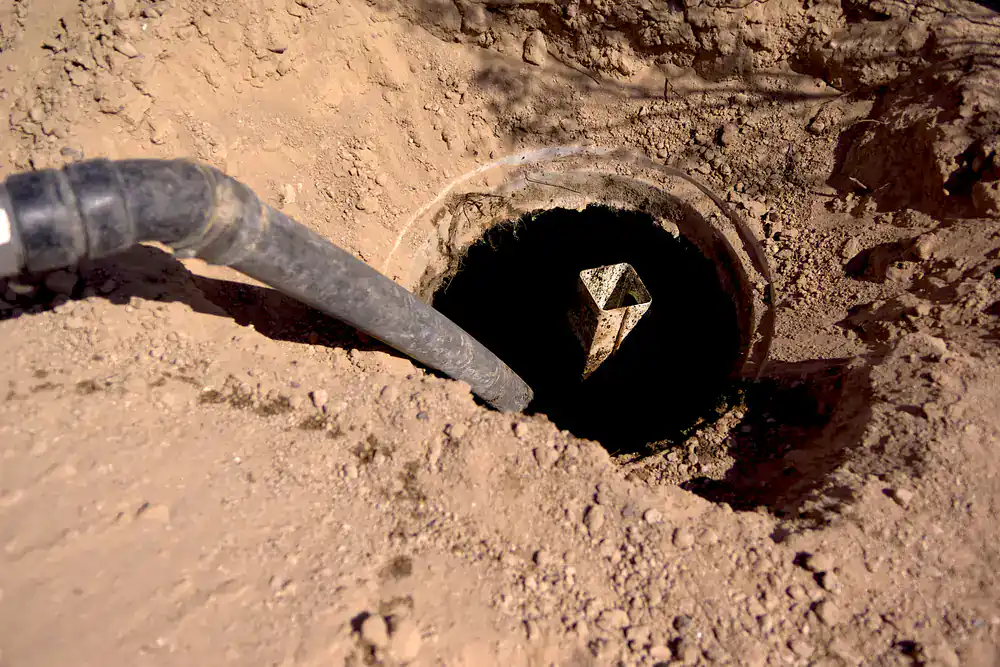
When our crew arrives, the first step is locating the tank. In Port Jefferson, this matters more than most places. Older homes especially those built before the 1970s often have lids buried under years of soil and landscaping. We specialize in locating hard-to-find cesspools and septic tanks, which is a real and common problem in a village where some homes predate World War II.
Once the lid is located and accessed, the tank is fully pumped not partially, not just the surface layer, but completely cleared of sludge and waste. After pumping, we check the condition of the system: baffles, tank walls, signs of infiltration, anything that warrants attention. You’ll hear what we found, what it means, and what if anything actually needs to be done.
Suffolk County regulations require any failed system to be upgraded rather than replaced in kind, so if there’s a real issue, you’ll get a clear picture of your options. Then we clean up and leave the property the way we found it.

Ready to get started?
Septic tank pumping is the core of what we do in Port Jefferson, but it rarely stops there. Older homes in this area particularly in the incorporated village and in adjacent communities like Belle Terre and Old Field often have interconnected issues. A sluggish drain and a backed-up tank and a clogged main line can all trace back to the same neglected system.
We offer drain cleaning, cesspool pumping, drywell cleaning, house trap replacements, main sewage line cleaning and replacement, and holding tank pumping for commercial properties near the harbor and ferry terminal.
Port Jefferson’s residential market is shaped by older housing stock, coastal soil conditions, and proximity to the harbor. Systems in low-lying areas near the waterfront are more susceptible to high water table conditions, which can accelerate wear on leach fields and cesspools. Routine pumping typically every one to two years for cesspools and every three to five years for septic tanks is the most cost-effective way to stay ahead of those conditions.
For homeowners preparing to sell in a market where median home values approach $710,000 or more, a documented pump-out and honest system assessment is a straightforward way to protect the transaction. We handle both residential and commercial accounts, available 24 hours a day, seven days a week, including weekends and holidays.