By submitting you consent to receive service-related texts from Drastic Drainage. Reply STOP to opt out. Msg & data rates may apply. Consent not required to book service.
Useful Links
A septic system that’s been quietly keeping up with two people all winter doesn’t automatically handle twelve guests rotating through a Southampton rental from June through September. The math doesn’t work in your favor.
When a system gets pushed past what it was sized for week after week, season after season sludge builds up faster, leaching pools strain, and what started as a slow drain becomes a real emergency at the worst possible time.
Getting your tank pumped before the season starts means you’re not gambling with a system that’s already running on borrowed time. It also means you know what you’re working with whether that’s a clean bill of health or a heads-up that something needs attention before it forces your hand.
For rental property owners managing a Southampton home from New York City, that peace of mind is worth a lot. You’re not there to notice the early signs. Your tenants won’t say anything until they can’t ignore it. A pump-out before the season and an honest assessment of what the technician actually found gives you the information you need to protect the property and the rental income that depends on it.
The standard guidance for a conventional septic tank is every three to five years, but that schedule assumes year-round occupancy at normal household levels. In Southampton, that assumption breaks down fast. If your property sits quiet from October through April and then hosts a rotating group of guests or renters from Memorial Day through Labor Day, your system is absorbing months of heavy use compressed into a short window. That accelerates sludge buildup significantly.
A good rule of thumb for Southampton properties that see heavy summer use: pump every one to two years, or at minimum before each rental season starts. If you don’t know when the system was last serviced which is extremely common with properties that have changed hands or been managed remotely start with a pump-out and an honest assessment of the system’s current condition. That gives you a real baseline instead of a guess.
Standard residential septic tank pumping in Suffolk County runs $300 to $600 for most homes, depending on tank size and how accessible the system is. A 1,000-gallon tank typically falls in the $225 to $400 range; a 2,000-gallon system runs closer to $400 to $600. Those are the real numbers not teaser rates designed to get a truck in your driveway before the actual invoice appears.
Where costs can climb is lid excavation. If your tank lid is buried which is common on older Southampton properties, particularly in the historic village area and in the wooded northern hamlets accessing it adds $300 to $1,200 depending on depth and what’s been built over it. We disclose that upfront, not after the fact. We provide a free estimate before any work begins, so you know what you’re committing to before anyone shows up.
Almost certainly, yes. Septic systems are sized based on the number of bedrooms in a home, calculated on standard occupancy assumptions. A four-bedroom rental property is designed with a certain daily waste load in mind not the reality of twelve people sharing the house during peak weeks. When a system is consistently overloaded relative to what it was designed for, sludge accumulates faster, and the leaching area takes on more stress than it was built to handle.
For rental property owners in Southampton, the practical answer is to schedule a pump-out before the rental season begins each year. That way you know the system is in good shape before the first tenants arrive, and you’re not fielding an emergency call from a renter on a Saturday night in August. It also protects you from the liability and lost rental income that comes with a system failure during your highest-earning weeks of the year.
Southampton Town adopted its own Innovative and Alternative Onsite Wastewater Treatment System requirement in July 2017, ahead of the broader Suffolk County regulatory changes that followed in 2019. Under Town Code Chapter 177, an I/A OWTS is required for all new residential construction and for substantial septic upgrades in Medium and High Priority Areas of the town’s Water Quality Improvement Plan. If your existing system fails and the required repair equals or exceeds 50% of the current system’s cost, an I/A OWTS upgrade is triggered rather than a like-for-like replacement.
What this means practically is that a failed cesspool in certain parts of Southampton cannot simply be replaced with another conventional cesspool. The upgrade to an advanced nitrogen-reducing system runs approximately $20,000 installed. Southampton Town does offer a rebate program through its Community Preservation Fund for income-eligible applicants in the regulated areas the Town’s CPF office at 631-287-5720 can provide details. The most important thing is knowing where your system stands before it fails, so you’re making decisions with time on your side rather than under pressure.
The honest answer is that most septic systems fail quietly for a long time before anything visible happens. By the time you’re seeing sewage surfacing in the yard, smelling something near the leaching area, or dealing with toilets that back up into the house, the system has usually been struggling for a while.
Early signs are easier to miss: drains that are a little slower than they used to be, a patch of lawn near the tank that stays unusually green, or a faint odor that only appears after heavy rain. In Southampton, the sandy glacial soils that cover most of the South Fork drain quickly which means contaminants move fast too. A failing system doesn’t always pool visibly on the surface the way it might in heavier soil.
That makes routine pumping and inspection more important here, not less, because the warning signs can be subtle right up until they’re not. A technician who actually assesses the system while the tank is open not just pumps and leaves gives you information you can act on before a quiet problem becomes an expensive one.
Yes. We serve all of Suffolk County, which includes the full geographic span of Southampton Town from Flanders and Riverside on the western edge, through Hampton Bays, Shinnecock Hills, Southampton Village, North Sea, Noyac, Water Mill, and Bridgehampton, out to Sagaponack and Westhampton Beach. The town covers 140 square miles and 18 hamlets, and the distance from the western hamlets to the eastern ones is significant. Service availability across that full range, including 24/7 scheduling, means you’re not limited to whoever happens to be closest.
For out-of-town property owners managing a Southampton home remotely, that reach matters. Whether the property is a historic cottage in the village or a newer compound further east along Montauk Highway, the same team, the same honest approach, and the same free estimate process applies. You don’t need to track down a different company for every part of the town.
Free, no-obligation estimates on cesspool, sewer, and drain work.
We get there quickly. No waiting days for a callback.
Backups don’t wait for business hours. Neither do we.
Fully licensed and insured across Long Island.
Up-to-date trucks and tools for cleaner, faster jobs.
Straight quotes, no surprises on the bill.
Hear from Our Customers
A septic system that’s been quietly keeping up with two people all winter doesn’t automatically handle twelve guests rotating through a Southampton rental from June through September. The math doesn’t work in your favor.
When a system gets pushed past what it was sized for week after week, season after season sludge builds up faster, leaching pools strain, and what started as a slow drain becomes a real emergency at the worst possible time.
Getting your tank pumped before the season starts means you’re not gambling with a system that’s already running on borrowed time. It also means you know what you’re working with whether that’s a clean bill of health or a heads-up that something needs attention before it forces your hand.
For rental property owners managing a Southampton home from New York City, that peace of mind is worth a lot. You’re not there to notice the early signs. Your tenants won’t say anything until they can’t ignore it. A pump-out before the season and an honest assessment of what the technician actually found gives you the information you need to protect the property and the rental income that depends on it.
We’ve been working on Long Island’s septic and cesspool systems for over 30 years. That’s the kind of experience that comes from working through every variation of what Long Island’s housing stock throws at you from pre-war properties in Southampton Village with original-era systems buried under decades of landscaping, to modern estate compounds out toward Sagaponack where regulatory requirements have shifted significantly since 2017.
We operate 24 hours a day, seven days a week, including weekends and holidays. That’s not a policy it’s how this business actually runs, which matters when a septic emergency surfaces on a Friday night in July and you need someone who picks up the phone.
What you won’t get from us is a technician who shows up and starts recommending work you don’t need. We tell you what we find, explain what’s actually required versus what’s optional, and let you make the call.
It starts with a free estimate. Before anyone pulls up to your property, you know what you’re looking at no surprises when the truck arrives, no number that changes once we’re on-site. That matters everywhere, but it matters especially in Southampton, where some contractors adjust their quotes based on what the driveway tells them about the property’s value.
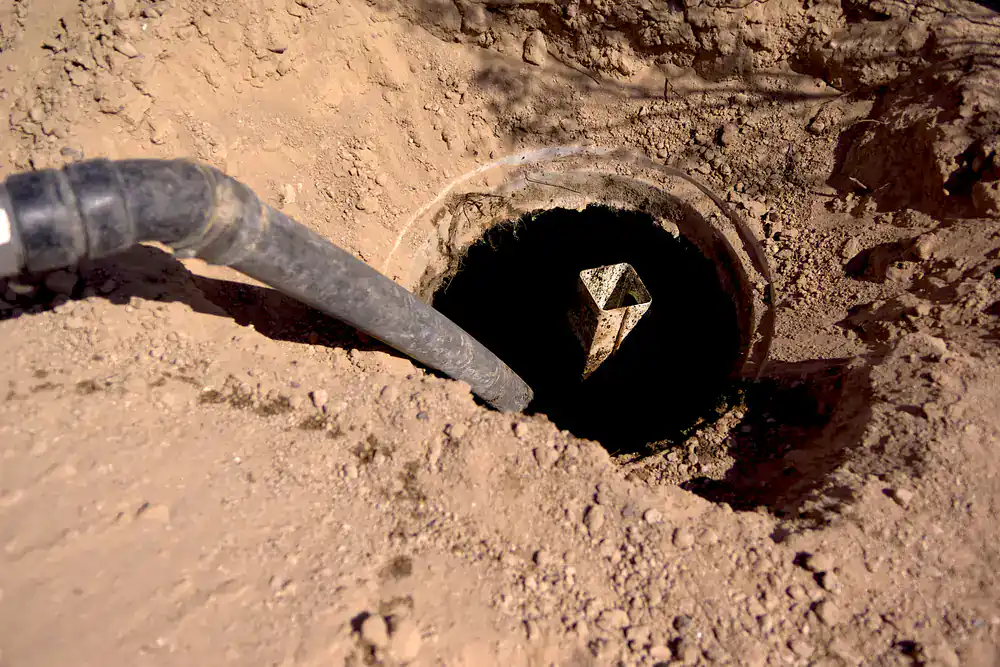
Once our technician is on-site, the first step is locating the tank and accessing the lid. On older Southampton properties particularly in the historic village area, in North Sea, or in the wooded hamlets further north lids are often buried under years of soil and landscaping with no records of their location. We specifically handle hard-to-find systems, so this isn’t a reason for a service call to stall.
After the lid is exposed, the tank gets fully pumped out not partially, not surface-level. All of the accumulated sludge and waste is removed and transported to a licensed disposal facility. While the tank is open, we assess the system’s condition: baffles, tank walls, signs of infiltration, and the general state of the leaching area. If something looks off, you’ll hear about it plainly.
Southampton Town’s I/A OWTS requirements mean that certain findings carry real regulatory implications you deserve to know that before you’re in a crisis, not after.

Ready to get started?
We handle the full range of what Southampton property owners typically need: septic tank pumping, cesspool pumping, drain cleaning, drywell cleaning, house trap replacements, and main sewage line cleaning and replacement. Residential and commercial properties are both covered. If you own a rental compound, a small commercial property in Southampton Village, or a private estate anywhere from Hampton Bays to Westhampton Beach, one call handles the scope.
Southampton sits in a unique regulatory environment. The town adopted its own I/A OWTS requirements in July 2017 ahead of the broader Suffolk County changes that followed in 2019 meaning that certain system failures or upgrades in Medium and High Priority Areas of the town’s Water Quality Improvement Plan require an advanced nitrogen-reducing system rather than a like-for-like replacement. A routine pump-out is often the first moment a homeowner learns their system is approaching that threshold. Getting that information from a technician who gives you an honest read rather than one who inflates the urgency gives you time to plan.
The sandy glacial soils that run through most of the South Fork drain well, but they also move contaminants quickly toward groundwater and toward the coastal water bodies that border Southampton on nearly every side. Shinnecock Bay is already documented as impacted by nitrogen from surrounding unsewered communities. Keeping your system properly maintained isn’t just a property issue it’s a direct factor in the water quality that defines this area.