
By submitting you consent to receive service-related texts from Drastic Drainage. Reply STOP to opt out. Msg & data rates may apply. Consent not required to book service.
Useful Links
When your cesspool is properly maintained or replaced, you stop guessing. No more slow drains you’re hoping will clear on their own. No more wet patches in the yard that appear after a heavy rain and make you wonder how serious it actually is. You know what you have, you know it’s compliant, and you’re not sitting on a problem that’s getting worse underground while you wait.
For Brightwaters homeowners specifically, that peace of mind carries extra weight. The village’s canal system — nearly a mile long, running south of Montauk Highway toward the Great South Bay — is directly downstream of every cesspool in the community. When a system starts leaching, it doesn’t travel somewhere abstract. It moves toward the water your neighbors kayak on.
Suffolk County has setback and overflow rules for systems near tidal waterways, and properties along East and West Concourse are subject to regulatory layers that inland communities simply don’t face. Getting the system right isn’t just about your property — it’s about what’s on the other side of your fence.
More than half of the homes in Brightwaters were built before 1950. That means a large portion of the village is sitting on cesspool systems that are 70 to 100 years old — well past the standard 20 to 40-year lifespan. A properly serviced or replaced system gives you a clear timeline instead of an unknown liability.
Yes, and it’s worth understanding before any work starts. Suffolk County has specific setback and overflow rules that apply to cesspool systems located near tidal waterways, and the Brightwaters Canal — which connects directly to the Great South Bay — qualifies. For properties along East and West Concourse and other canal-adjacent streets, any installation, major repair, or replacement requires SCDHS review that accounts for proximity to the waterway. This isn’t a formality; it’s a real compliance requirement that affects what type of system can be installed and where.
If you’re dealing with a failed system near the canal, a conventional cesspool replacement is no longer an option under Suffolk County’s 2019 ban anyway. The replacement must be an Innovative/Alternative onsite wastewater treatment system. The good news is that these systems qualify for the county’s Septic Improvement Program grant, which can cover a significant portion of the cost. We handle the permit filing with SCDHS and can walk you through the grant application process so you’re not navigating the paperwork alone.
For most households, pumping every one to three years is the general guidance — but for older homes in Brightwaters, the calculus is different. Systems installed in the 1920s, 1930s, and 1940s were often built without modern access points and may have been sized for smaller households than the ones using them today. They’re also operating in soil conditions with a relatively high water table, which reduces absorption capacity and means the system fills faster than it would in a drier, more inland location.
If you’ve never had your cesspool pumped, or if it’s been more than a few years, the priority isn’t just pumping — it’s assessment. A system that old may be approaching the end of its functional life, and knowing where it stands is more valuable than a routine pump-out that delays the inevitable. We can inspect the system, tell you what it’s actually doing, and give you a clear picture of whether you’re looking at maintenance or something more significant. That information matters, especially if you’re planning to sell.
The most common early signs are slow drains throughout the house — not just one fixture, but multiple — along with gurgling sounds in the pipes, a sewage odor near the yard or in the basement, and wet or unusually green patches of grass above where the system is buried. In Brightwaters, wet patches are especially worth paying attention to after heavy rain or during spring snowmelt, because the South Shore’s high water table can temporarily overwhelm an aging system’s absorption capacity and push problems to the surface faster than you’d expect.
Don’t wait to see if it gets better on its own. A cesspool that’s surfacing sewage or backing up into the house has already crossed from a maintenance issue into an emergency. The cost of addressing a backup after it overflows into a basement is significantly higher than the cost of a pump-out or repair caught early. Call us at (631) 422-4122 to get someone out for an assessment. If it turns out to be minor, you’ll know. If it’s more serious, you’ll have the information you need to make a decision before the situation forces one on you.
Free, no-obligation estimates on cesspool, sewer, and drain work.
We get there quickly. No waiting days for a callback.
Backups don’t wait for business hours. Neither do we.
Fully licensed and insured across Long Island.
Up-to-date trucks and tools for cleaner, faster jobs.
Straight quotes, no surprises on the bill.
Hear from Our Customers

When your cesspool is properly maintained or replaced, you stop guessing. No more slow drains you’re hoping will clear on their own. No more wet patches in the yard that appear after a heavy rain and make you wonder how serious it actually is. You know what you have, you know it’s compliant, and you’re not sitting on a problem that’s getting worse underground while you wait.
For Brightwaters homeowners specifically, that peace of mind carries extra weight. The village’s canal system — nearly a mile long, running south of Montauk Highway toward the Great South Bay — is directly downstream of every cesspool in the community. When a system starts leaching, it doesn’t travel somewhere abstract. It moves toward the water your neighbors kayak on.
Suffolk County has setback and overflow rules for systems near tidal waterways, and properties along East and West Concourse are subject to regulatory layers that inland communities simply don’t face. Getting the system right isn’t just about your property — it’s about what’s on the other side of your fence.
More than half of the homes in Brightwaters were built before 1950. That means a large portion of the village is sitting on cesspool systems that are 70 to 100 years old — well past the standard 20 to 40-year lifespan. A properly serviced or replaced system gives you a clear timeline instead of an unknown liability.
We’re based in West Babylon — a few miles west of Brightwaters along the same South Shore corridor. That proximity isn’t a marketing detail. It means the crew that shows up at your door has been working in this specific regulatory environment, with these specific soil conditions and SCDHS permit requirements, for over three decades.
We know how Article 6 of the Suffolk County Sanitary Code actually plays out in practice — not just what it says on paper. Our license (LW-63684), insurance, and bond back up every job we take on.
When you call, a real person answers. When our technician arrives, we explain what we found and what it means — in plain language, not in a way that leaves you more confused than when we pulled up. Customers have called out Mike, Lucas, and George by name in reviews for exactly that reason.
We handle everything from routine cesspool pumping and maintenance to full installations, video pipe inspections, cesspool location services, and real estate certifications. One company, one call, no handoffs.
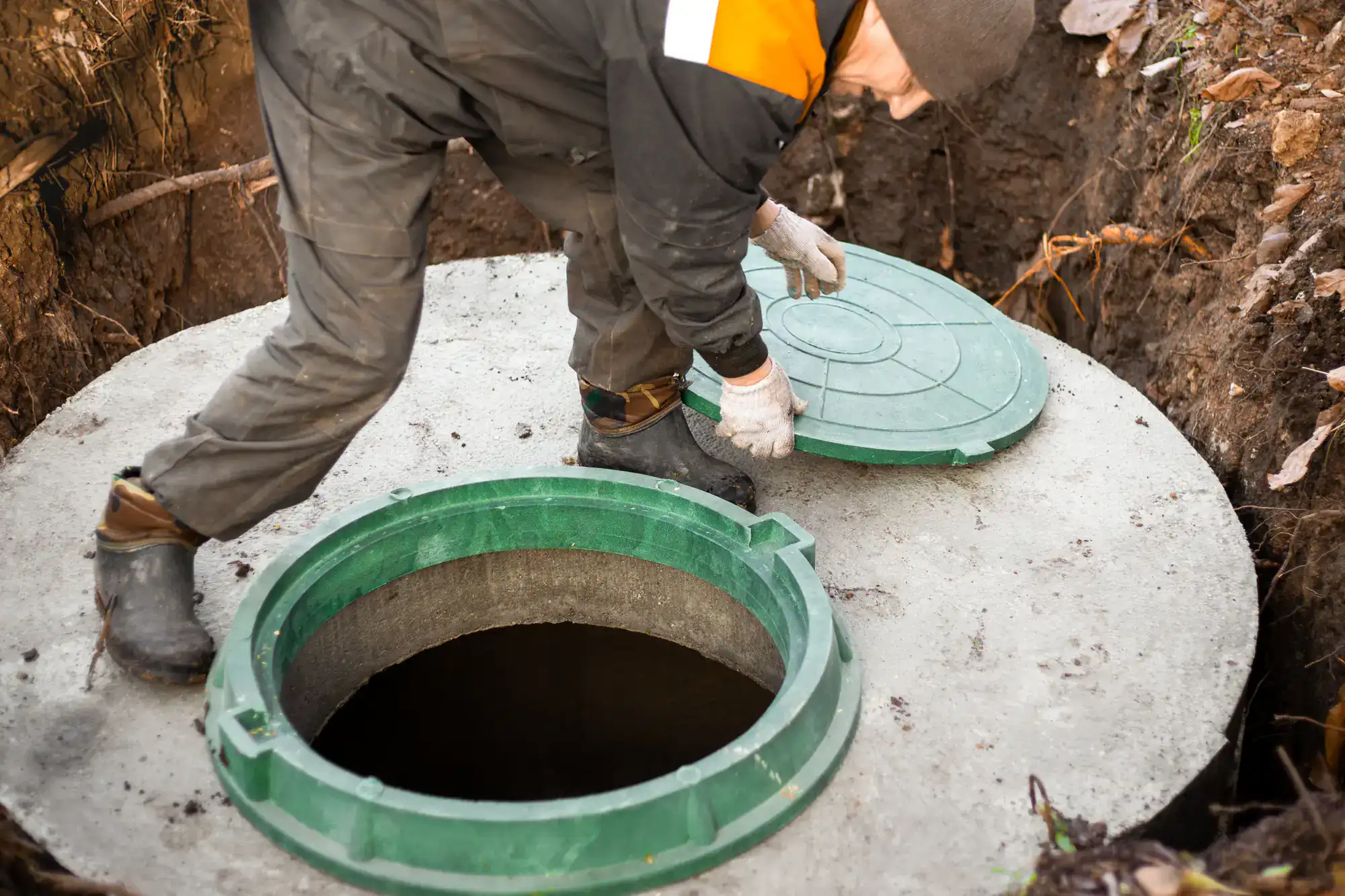
It starts with a phone call to (631) 422-4122. A real person picks up, gets the details, and gives you a realistic timeframe — not a four-hour window with no follow-up. If it’s an emergency, that urgency is treated seriously. For Brightwaters properties near the canal, a backup isn’t something to leave until morning, and our 24-hour emergency service is actual availability, not just a claim on a website.
Once on site, the first step is assessment. For older homes — and in Brightwaters, many predate 1940 — that often means locating the system first. A lot of these houses were built before modern access requirements existed, so there’s no visible cover.
We specialize in finding these systems, which is a prerequisite for everything that follows. If there’s uncertainty about what’s happening underground, a waterproof video camera goes in before any digging starts. That means targeted work, not exploratory excavation through a landscaped yard.
From there, the scope becomes clear: routine pumping, repair, leaching pool service, or full replacement. If replacement is needed, we handle the SCDHS permit process and can walk you through the Suffolk County Septic Improvement Program, which currently offers up to $45,000 in combined grant funding for qualifying Innovative/Alternative system installations. After the work is done, you get documentation — whether that’s for your own records or for a real estate closing that’s coming up fast.

Ready to get started?
Brightwaters isn’t a one-size-fits-all cesspool market. The combination of pre-1950 housing stock, a canal that connects to the Great South Bay, a high water table at roughly 23 feet of elevation, and an active real estate market with median home values approaching $900,000 — that’s a specific set of conditions that requires a provider who understands all of it, not just the basics.
We offer the full scope: cesspool cleaning and pumping, cesspool maintenance programs, cesspool installation, cesspool repair, leaching pool service, video pipe inspection, cesspool location for systems with no visible access point, house trap replacements, main sewage line cleaning and replacement, storm drain cleaning, and real estate certifications.
The certification service is worth calling out specifically for Brightwaters. When a home in the village goes to closing — and in this market, homes move in roughly 40 days — the cesspool inspection and documentation required for the property transfer is a hard deadline, not a suggestion. A certification from a licensed operator protects the transaction and the buyer’s attorney doesn’t have to ask twice.
For canal-adjacent properties on East or West Concourse, the work also accounts for Suffolk County setback and overflow requirements specific to tidal waterways. That’s not something every cesspool company navigates regularly. We do.
